





China’s GACC Order 280 takes effect June 1, 2026, introducing stricter registration rules for overseas food manufacturers. CBEC sellers remain exempt—but general trade requires registration. This guide covers everything you need to know.
Table of Contents
- What Is GACC Order 280?
- Key Changes Under GACC Order 280
- Three Import Channels for Food into China
- Channel-by-Channel Tax Comparison
- General Trade GACC Registration: Step-by-Step Guide
- CBEC vs. General Trade: Which Channel Is Right for You?
- Common Compliance Pitfalls (And How to Avoid Them)
- Need Help with Your China Food Import Strategy?
- Ongoing Regulatory Monitoring
- What Is GACC Order 280?
GACC Order 280, officially titled the Regulations of the People’s Republic of China on the Registration Administration of Overseas Manufacturers of Imported Food, was issued on October 14, 2025, and takes effect June 1, 2026, replacing the current Order No. 248.
The regulation applies to any overseas enterprise engaged in the production, processing, or storage of food for export to the Chinese market, excluding food additives and food-related products. GACC implements a risk-based, categorized management system, meaning the registration method and requirements depend on your products’ risk level.
Currently, over 96,000 food enterprises from 178 countries and regions are registered with GACC, and this number continues to grow.
- Key Changes Under GACC Order 280
📅 Effective Date
June 1, 2026
🔄 Registration Types: Two Main Pathways
| Pathway | Description |
| Official Recommendation Registration | For higher-risk categories (see list below), manufacturers must be approved by their home country’s competent authority, which issues a review report and recommendation letter to GACC |
| Self-Registration | All other food products can be registered directly by the manufacturer through the GACC system |
📋 17 Categories Requiring Official Recommendation Registration
Under GACC Order 280, the official recommendation list has been reduced from 18 categories to 17, with oilseeds, fresh vegetables, dried beans, and unroasted coffee/cocoa beans moved to a separate agricultural products framework:
- Meat and meat products
- Casings
- Edible bird’s nests and bird’s nest products
- Bee products
- Eggs and egg products
- Edible oils and fats
- Filled pasta products
- Edible cereals
- Cereal milling products and malt
- Dehydrated vegetables
- Seasoning powders
- Nuts and seeds
- Dried fruits
- Special dietary foods
- Health foods (supplements)
- Dairy products
- Aquatic products (seafood)
⏱️ Registration Validity
Once approved, registration is valid for 5 years. Most registrations renew automatically upon expiry—with two exceptions requiring proactive renewal 3–12 months before expiration: meat and meat products, and edible bird’s nests and bird’s nest products.
🧊 New: Cold Storage Registration
For the first time, overseas cold storage facilities storing land animal-derived foods and aquatic products must register with GACC.
🏷️ Labelling Requirements
Registered manufacturers must mark product packaging with either their GACC registration number (在华注册编号) or the registration number approved by their local competent authority.
💰 Registration Fee
GACC registration is completely free through the official portal at https://cifer.singlewindow.cn. Be cautious of fraudulent websites charging fees.
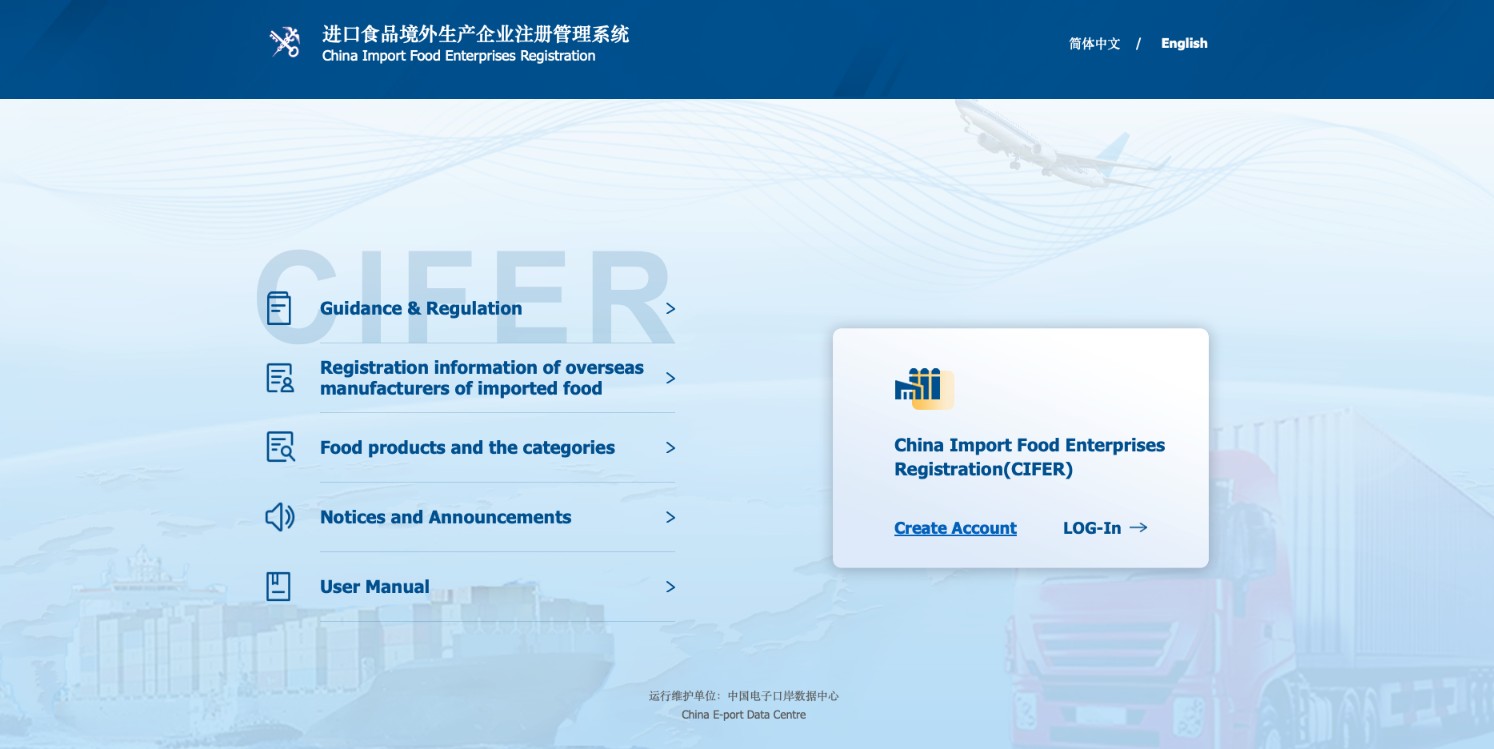
For the most current list of affected food products and HS codes (updated regularly) — Bookmark this link to keep your information current without rewriting internal guides. 👉 https://cifer.singlewindow.cn
- Three Import Channels for Food into China
China offers three primary pathways for importing food, each with different rules, taxes, and requirements:
📦 Channel 1: CBEC (Cross-Border E-Commerce)
Best for: Testing the market, small to medium volumes, direct-to-consumer sales
CBEC allows overseas brands to sell directly to Chinese consumers via cross-border e-commerce platforms such as Tmall Global, JD Worldwide, and Douyin Global. Products are stored in bonded warehouses or shipped directly from overseas.
CBEC Key Features:
- Products regulated as personal-use items, not commercial cargo
- No GACC manufacturer registration required
- Must be on the CBEC Positive List (跨境电子商务零售进口商品清单)
- Available in two models:
- Bonded Warehouse (1210): Bulk shipment to bonded warehouse before individual orders
- Direct Shipping (9610): Direct-to-consumer from overseas
⚠️ Current CBEC Positive List: As of 2026, the Positive List includes 1,476 8-digit HS codes. However, certain products remain restricted — meat products, sterilized milk, egg yolk, and bird’s nest products are prohibited from entering via CBEC. Always verify your product’s eligibility before planning a CBEC launch.
🚢 Channel 2: General Trade
Best for: Large volumes, offline retail, traditional e-commerce (Tmall/JD flagship stores)
General trade treats imported food as commercial cargo entering the Chinese market. Products must meet all China food safety standards before import.
General Trade Key Features:
- GACC registration required for all overseas manufacturers
- Products undergo full customs inspection
- Chinese labelling required on all packaging
- Full tax liability (see Section 4 for rates)
✈️ Channel 3: C2C (Personal Parcels)
Best for: Low-volume direct sales, individual consumers
C2C (consumer-to-consumer) imports refer to personal parcels shipped directly to individual consumers, typically via postal or courier services.
C2C Key Features:
- No GACC registration required (personal use exemption)
- Subject to Postal Parcel Tax (行邮税) — a combined tax covering customs duty, VAT, and consumption tax
- Food items are taxed at 13% under the postal parcel tax system
- 50 RMB tax exemption per parcel applies (orders below threshold are tax-free)
- Strict “personal use, reasonable quantity” limit — shipments deemed commercial may be reclassified and face higher taxes or rejection
- Non-commercial channel — companies looking to expand and grow in China should avoid using this C2C channel
- Channel-by-Channel Tax Comparison
Understanding tax differences across channels is critical for cost planning. Here’s how each channel stacks up:
| Tax Component | CBEC | General Trade | C2C (Postal Parcel) |
| Applicable Tax Regime | CBEC Comprehensive Tax | Customs Duty + VAT + Consumption Tax | Postal Parcel Tax (行邮税) |
| Tariff Rate | 0% (within thresholds) | Most-Favoured Nation (MFN) rate (typically 5–25% depending on product; some products enjoy lower provisional rates — 935 commodities in 2026) | Included in 行邮税 |
| VAT Rate | 70% of standard rate | Standard rate (food typically 9% or 13%) | Included in 行邮税 |
| Consumption Tax | 70% of standard rate (if applicable) | Full rate for applicable products | Included in 行邮税 |
| Combined Tax Rate | ~11.2% for most food | Varies by product (typically 15–40%+) | 13% for food |
| Order/Value Limits | ≤5,000 RMB per order; ≤26,000 RMB per year | No individual limits | “Reasonable personal use” quantity |
| De Minimis Exemption | None (within limits) | None | 50 RMB exemption per parcel |
| GACC Registration Required | No | Yes | No |
Example Tax Calculation (Food product with 10% MFN duty, 13% standard VAT, no consumption tax):
| Channel | Calculation | Effective Rate |
| CBEC | (13% × 70%) = 9.1% | ~9.1% |
| General Trade | 10% duty + 13% VAT = 24.3% (duty applies to CIF value, VAT applies to CIF + duty) | ~24.3% |
| C2C | Flat 13% of Postal Parcel Tax (行邮税) | 13% |
Key takeaway: CBEC offers the lowest tax burden for eligible products within the volume limits, making it ideal for market entry and testing. General Trade has the highest tax burden but no volume restrictions. C2C offers moderate taxation but is restricted to low-volume personal shipments; not advisable for commercial use.
- General Trade GACC Registration: Step-by-Step Guide
For those exploring general trade channels, here is the complete GACC registration process:
Step 1: Determine Your Product Category
Check whether your food product falls under the 17 categories requiring official recommendation or qualifies for self-registration.
Step 2: Prepare Your Documentation
Required for all applicants:
- Enterprise registration application information
- Enterprise identity proof (business license or certificate from local competent authority)
- Compliance statement affirming adherence to GACC requirements
For products on the official recommendation list:
- Review and inspection report from your home country’s competent authority
- Recommendation letter from the same authority
📝 Note: Application materials can be submitted in either Chinese or English.
Step 3: Submit Your Application
Access the GACC Import Food Enterprise Registration (CIFER) system at https://cifer.singlewindow.cn to create an account and submit your application.
⚠️ Critical: GACC registration is completely free through the official portal. Beware of fraudulent websites charging fees.
Step 4: GACC Review
GACC will conduct an assessment through document review, video inspections, or on-site inspections, depending on risk level.
Step 5: Receive Your Registration Number
If approved, GACC issues your Chinese registration number (在华注册编号).
Step 6: Update Your Packaging and Import Declarations
Once registered, ensure your product packaging displays the registration number. For import declarations, fill “519” under “Product Qualification” and “食用” under “Purpose”.
Step 7: Maintain Compliance for Renewal
Most registrations automatically renew after 5 years. However, meat products and bird’s nest products require proactive renewal 3–12 months before expiration.
Registration validity check: You can verify registration status and validity via the GACC official website or the registration system’s “Imported Food Overseas Manufacturer Registration List” function.
- CBEC vs. General Trade: Which Channel Is Right for You?
Choosing the right channel depends on your business goals, product type, and long-term strategy:
| Factor | CBEC | General Trade |
| Market access speed | Fast (weeks) | Slow (months, plus GACC registration) |
| GACC registration | Not required | Required |
| Chinese labelling | Not required (original packaging OK) | Required (Chinese label on each unit) |
| Product eligibility | Must be on Positive List | All food categories (with registration) |
| Sales channels | Cross-border e-commerce platforms only | All channels (offline, traditional e-commerce, CBEC) |
| Volume limits | Yes (5,000 RMB/order; 26,000 RMB/year per consumer) | No limits |
| Tax rate | ~11.2% for most food | Higher (varies by product) |
| Best for | Market testing, small-medium volumes, D2C brands | Large volumes, full market penetration |
Recommended strategy for most overseas food brands:
- Start with CBEC to test the market, build brand awareness, and validate product-market fit — all without the complexity and cost of GACC registration.
- Scale with General Trade once demand is proven and you’re ready for full China market access.
💡 Important: If you plan to sell through traditional Tmall/JD flagship stores (not cross-border channels), you’ll need GACC registration. However, CBEC platforms like Tmall Global and JD Worldwide allow direct sales without registration. Choose your platform wisely based on your registration status.
- Common Compliance Pitfalls (And How to Avoid Them)
Even with the right channel strategy, many food exporters run into trouble. Here are the most common compliance mistakes — and how to avoid them:
❌ Pitfall 1: Selling Products Not on the CBEC Positive List
The problem: Products with HS codes not on the Positive List cannot enter via CBEC. One company in 2025 had its goods rejected because the HS code fell outside the Positive List — resulting in cargo returned at significant cost.
How to avoid: Always verify your product’s HS code against the latest Positive List before shipping. If your product is not on the list, you must use general trade.
❌ Pitfall 2: No Chinese Label on General Trade Products
The problem: In 2025, a company was fined for selling imported food without Chinese labels (plus containing a prohibited ingredient, NMN). Fines and product seizures followed. Another case involving imported infant formula without Chinese labels resulted in an 18,000 RMB fine.
How to avoid: For general trade, Chinese labels are mandatory on each unit. For CBEC, original packaging is acceptable — but the importer must provide Chinese translation on the product listing page, and consumers must be informed that the product may not meet China domestic standards.
❌ Pitfall 3: Unapproved or Undeclared Ingredients
The problem: In February 2026 alone, 452 batches of food were denied entry into China. The top reasons included label non-compliance, microbiological contamination, heavy metal issues, undeclared GMO ingredients, and additive violations. Japanese wheat flour shipments were rejected for containing unapproved GMOs. A 156-ton shipment of frozen coconut milk was denied entry due to excessive coliform bacteria.
How to avoid: Conduct thorough ingredient review against China’s food additive and contaminant standards (GB 2760, GB 2762). For GMO-derived products, confirm regulatory status before shipping.
❌ Pitfall 4: Misclassifying Trade Channels
The problem: Using CBEC channels for products intended for commercial resale or exceeding volume limits can trigger reclassification as general trade, resulting in back taxes, penalties, and potential blacklisting.
How to avoid: Maintain strict channel separation. CBEC is for B2C only — not for wholesale distribution.
❌ Pitfall 5: Assuming GACC Registration Is Automatic
The problem: While most registrations auto-renew, meat and bird’s nest products require proactive renewal 3–12 months before expiration. Missing the window means registration lapses and imports stop.
How to avoid: Track your registration expiry dates. Set reminders 12 months ahead for renewal-required categories.
❌ Pitfall 6: Paying for “GACC Registration Services”
The problem: Fraudulent websites charge fees for GACC registration — but registration through the official CIFER system is completely free.
How to avoid: Only use https://cifer.singlewindow.cn. Be skeptical of any third-party charging “registration fees.”
❌ Pitfall 7: Label Non-Compliance Even Within CBEC
The problem: Even though CBEC products don’t require Chinese labels on the physical package, product listings must still include accurate Chinese translations of ingredients, allergens, and origin information. In one 2026 case, authorities investigated a CBEC-imported supplement for alleged origin fraud and misleading claims.
How to avoid: Ensure your CBEC product listings provide complete, accurate Chinese-language information. Don’t rely on the exemption as a reason to cut corners on transparency.
❌ Pitfall 8: Failing to Submit Proper Declarations for General Trade
The problem: Under GACC Order 280, general trade imports must include the manufacturer’s registration number in customs declarations — specifically, in the “Product Qualification” field with certificate code “519” and “食用” under “Purpose.” Failure to provide this results in customs rejecting the declaration.
How to avoid: Train your customs brokers on the new requirements. Double-check every declaration before submission.
✅ Summary: Compliance Checklist
| Compliance Item | CBEC | General Trade | C2C |
| GACC registration | ❌ Not required | ✅ Required | ❌ Not required |
| Positive List check | ✅ Required | ❌ Not applicable | ❌ Not applicable |
| Chinese label on product | ❌ Not required | ✅ Required | ❌ Not required |
| Chinese translation on listing | ✅ Required | ✅ Required | ❌ Not applicable |
| Customs declaration with registration number | ❌ Not applicable | ✅ Required | ❌ Not applicable |
| Track expiry for renewal | ❌ Not applicable | ✅ Required (esp. meat & bird’s nest) | ❌ Not applicable |
| Volume/order limits | ✅ 5,000 RMB/order; 26,000 RMB/year | ❌ No limits | ✅ “Reasonable quantity” |
- Need Help with Your China Food Import Strategy?
Navigating China’s food import regulations can be complex, but with the right partner, it doesn’t have to be overwhelming. As a one-stop CBEC solution provider, MyMyPanda helps overseas food brands successfully enter the Chinese market through compliant cross-border e-commerce channels — no GACC registration required except for higher-risk products (Health foods, Special dietary foods, Dairy products, Meat products). This risk is particularly acute for these product types because they are already subject to stricter controls under general trade.
👉 Contact MyMyPanda Today to Start Your CBEC Journey

Our team provides end-to-end support, including:
- CBEC Positive List verification and product eligibility assessment
- Supply chain, customs clearance and bonded warehouse logistics
- Platform onboarding (Tmall Global, JD Worldwide, Douyin Global, RedNote etc.)
- Compliance documentation preparation
- Ongoing regulatory monitoring and updates
- WeChat mini-program development & ecommerce platform setup
- Ecommerce operations & management across marketplaces and social platforms
- Content marketing, store livestream and KOL livestream
- Ecommerce fulfilment and country-wide last mile logistic delivery
- Payment collection and remittance in any currency
- Ongoing Regulatory Monitoring
GACC Order 280’s CBEC exemption is currently in effect. However, the regulation states that CBEC imports “shall be handled in accordance with relevant provisions” — and those “relevant provisions” could be amended in the future.
MyMyPanda will continue to monitor official channels, including the GACC website (http://jckspj.customs.gov.cn/) and the CBEC Positive List, for any future announcements that might clarify or alter the CBEC registration requirements for specific product categories. We will provide timely updates to our clients as the regulatory landscape evolves.
Frequently Asked Questions
Q: Do I need GACC registration for my food products sold on Tmall Global or JD Worldwide?
A: No. CBEC retail imports — including those sold through major cross-border platforms — are regulated as personal-use items and do not require GACC manufacturer registration.
Q: What about health foods and supplements sold via CBEC?
A: The exemption applies equally. Unlike general trade (which requires both SAMR registration and GACC registration), CBEC health foods can enter China without either, subject to Positive List inclusion.
Q: How long does GACC registration take for general trade?
A: Processing times vary by product risk level and registration pathway. The official recommendation pathway takes longer due to home country authority involvement. Start the process at least 4–6 months before your first general trade shipment.
Q: What happens if I use CBEC channels but my product isn’t on the Positive List?
A: Customs will reject the shipment. In some cases, misclassification may result in penalties. Always verify Positive List status before shipping.
Q: Where can I find the official GACC registration portal?
A: https://cifer.singlewindow.cn[reference:49]. Registration is completely free. The official GACC food safety portal is http://jckspj.customs.gov.cn/.
Q: Is there any food category that requires GACC registration even for CBEC?
A: Based on available official information, no. The CBEC exemption applies uniformly across all food products sold via CBEC channels. However, the “relevant provisions” clause in GACC Order 280 means this status could change in the future. MyMyPanda will monitor and update clients accordingly.
Key Takeaways
| Aspect | Details |
| GACC Order 280 Effective Date | June 1, 2026 |
| CBEC GACC Registration | Currently exempt — not required |
| General Trade GACC Registration | Required for all food manufacturers |
| CBEC Tax Rate (most food) | ~11.2% comprehensive tax |
| C2C Tax Rate (food) | 13% 行邮税 (postal parcel tax) |
| CBEC Order Limits | ≤5,000 RMB/order; ≤26,000 RMB/year per consumer |
| CBEC Positive List | 1,476 8-digit HS codes (verify your product) |
| Prohibited CBEC Items | Meat products, sterilized milk, egg yolk, bird’s nest |
| Official Recommendation Categories | 17 food categories (see Section 2) |
| Registration Validity | 5 years (auto-renew for most; meat & bird’s nest require proactive renewal) |
| Official Registration Portal | https://cifer.singlewindow.cn |
| Registration Fee | Free |
| Top Compliance Pitfalls | Positive List errors, label issues, unapproved ingredients, channel misclassification |
Disclaimer: This article is for informational purposes only and does not constitute legal or tax advice. Regulations may change, and compliance requirements vary based on specific products and circumstances. While the CBEC exemption is currently in effect, the “relevant provisions” clause in GACC Order 280 means the regulatory landscape could evolve. Always consult with qualified legal and compliance professionals for guidance on your specific situation.
