


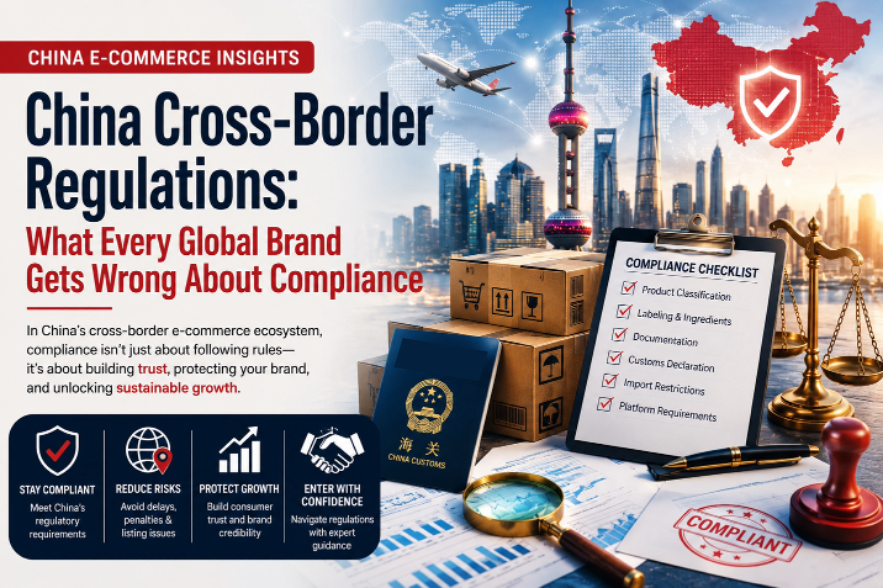
In March 2024, a European health supplement company was preparing for what should have been a successful quarter in China. The brand had already gained traction through cross-border e-commerce channels. Consumer demand was growing. Sales forecasts looked promising. Marketing campaigns had been approved, influencers had been engaged, and inventory was ready to move.
Then the launch stalled.
The issue was not product quality. It was not pricing. It was not demand. It was compliance. A seemingly minor issue relating to product classification and documentation created delays that affected marketplace approvals and disrupted campaign timelines. By the time the issue was resolved, competitors had already captured much of the momentum the brand had worked months to build.
Stories like this are far more common than many international companies realise.
When brands discuss entering China, conversations often focus on consumers, platforms, and marketing. Yet one of the biggest determinants of success frequently receives attention only after problems appear: regulatory readiness. In China’s cross-border e-commerce ecosystem, compliance is not simply an operational requirement. It is increasingly a competitive advantage.
The Scale of the Opportunity
China’s cross-border e-commerce market has grown into one of the world’s largest and most dynamic digital trade ecosystems. According to the General Administration of Customs of China, cross-border e-commerce imports and exports reached RMB 2.84 trillion (approximately USD 392 billion) in 2025, representing a 4.8% increase year-over-year and accounting for 6.2% of China’s total merchandise trade (General Administration of Customs of China, 2026). Both import and export volumes reached record highs, with imports totalling RMB 570.2 billion (General Administration of Customs of China, 2026).
In the first half of 2025 alone, cross-border e-commerce imports and exports reached RMB 1.37 trillion, growing 10.3% year-over-year and outpacing overall merchandise trade growth by 7.4 percentage points (General Administration of Customs of China, 2025). The United States remained the largest import source, accounting for 14.7% of all cross-border e-commerce imports, followed by Germany and Japan at 10.2% each (General Administration of Customs of China, 2025).
China Cross-Border E-Commerce Market Growth (2021–2026)
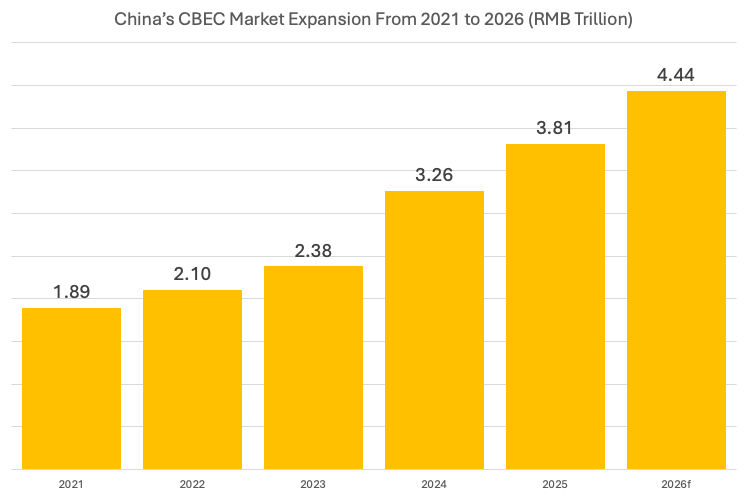 Data source: AskCI (2025); General Administration of Customs of China (2026)
The broader trajectory is equally impressive. Cross-border e-commerce now accounts for 6.2% of China’s total merchandise trade, up 0.4 percentage points from the previous year (General Administration of Customs of China, 2026). According to the Ministry of Commerce, key cross-border e-commerce import platforms saw retail sales grow by 5.6% in 2025 (Ministry of Commerce, 2026). Imported consumer goods — particularly beauty products, cosmetics, personal care items, food, and health supplements — continue to dominate cross-border e-commerce imports, accounting for 27.2% of all imports in 2025 (General Administration of Customs of China, 2026).
For global brands, the appeal is obvious. Cross-border e-commerce lowers barriers to entry while providing access to one of the world’s largest consumer markets. However, lower barriers do not eliminate regulatory requirements. They simply change them.
The Compliance Misconception
One of the most common misunderstandings among foreign brands is the belief that cross-border e-commerce allows companies to ignore regulations. In reality, cross-border e-commerce operates within a structured regulatory framework. Products still need to comply with platform requirements, customs regulations, import rules, and category-specific standards. The difference is that the framework is designed specifically for cross-border transactions rather than traditional imports.
Many companies discover this distinction only after encountering delays. The challenge is not that China’s regulations are unusually restrictive. The challenge is that many international brands attempt to apply assumptions from their home markets to an entirely different regulatory environment.
China’s cross-border e-commerce regulatory framework operates through two primary models. The first is “网购保税进口” (bonded warehouse import, customs code 1210) , where goods are pre-stocked in bonded warehouses within China’s pilot free trade zones and released upon consumer purchase. The second is “直购进口” (direct purchase import, customs code 9610) , where goods are shipped directly from overseas to Chinese consumers. Each model carries distinct compliance requirements, documentation obligations, and timelines.
Participating enterprises must register with local customs authorities. Cross-border e-commerce platform enterprises, logistics enterprises, and payment enterprises must complete registration with their local customs office. Overseas cross-border e-commerce enterprises must appoint a domestic agent to handle registration on their behalf.
CBEC Import Models Comparison
This comparison table explains which import pathway best suits a brand’s business model.
| Feature | Bonded Warehouse (1210) | Direct Purchase (9610) |
| Inventory Location | Bonded warehouse in China pilot zone | Overseas warehouse |
| Delivery Time | 2–5 days | 7–15 days |
| Customs Clearance | Batch clearance upon warehouse entry | Individual clearance per order |
| Minimum Order Volume | Higher (bulk shipment required) | Lower (per-order shipping) |
| Cost Efficiency | More cost-effective at scale | Higher per-unit shipping costs |
| Best For | Established brands with predictable demand | Testing new products, low-volume entry |
| Return Processing | Simpler (goods already in China) | More complex (cross-border returns) |
Data source: Lianyungang Development Zone Customs (2025); Shanghai Jungle (2026)
The Evolving Regulatory Landscape
China’s regulatory environment is often described as complex. A more accurate description might be dynamic. Consumer expectations change. New product categories emerge. Technology evolves. Cross-border trade expands. Regulations evolve alongside these developments.
In 2025 alone, several significant regulatory developments shaped the cross-border e-commerce landscape. In April 2025, the General Administration of Customs issued Announcement No. 79, clarifying procedures for the destruction and return of bonded warehouse inventory. The policy was designed to “promote the healthy development of cross-border e-commerce” and “effectively prevent substandard products from entering the domestic market” while “better protecting consumer rights” (General Administration of Customs of China, 2025b).
In September 2025, the State Administration for Market Regulation, in collaboration with the Ministry of Commerce, issued draft regulations on the recall of cross-border e-commerce retail imported food products, reinforcing the principle that imported products must meet the same safety standards as domestically produced goods (State Administration for Market Regulation, 2025). The draft regulations reflected an ongoing commitment to strengthening food safety oversight across all channels, including cross-border e-commerce.
In March 2026, the General Administration of Customs announced the nationwide rollout of cross-border returns for retail export goods, allowing returns to be processed through any customs office rather than requiring return to the original port of export (General Administration of Customs of China, 2026b). This measure was designed to reduce logistical friction and improve the consumer experience while maintaining compliance oversight.
Categories such as health supplements, cosmetics, food products, infant nutrition, and personal care products receive significant regulatory attention because they directly affect consumer wellbeing. From a regulatory perspective, the objective is not merely market control. It is consumer protection. Brands that understand this perspective are often better equipped to navigate compliance requirements effectively.
The Cost of Getting Compliance Wrong
When companies think about compliance risks, they often focus on fines or penalties. In practice, the commercial impact is usually far broader. A compliance issue can delay product launches, disrupt promotional campaigns, affect platform approvals, create uncertainty among partners and distributors, and most importantly, damage momentum.
In China’s highly competitive digital environment, timing matters. Consumer attention moves quickly. Trends emerge and disappear rapidly. Delayed market entry can result in missed opportunities that are difficult to recover later.
The risks extend beyond delayed launches. In May 2025, French luxury brand Dior became the first foreign brand prosecuted for non-compliant cross-border data transfers in China. The company was found to have transferred personal information from its Chinese customers to servers in France without following required legal mechanisms, failing to obtain separate consent from users, and failing to implement appropriate security measures such as encryption and de-identification (China Briefing, 2025; Lexology, 2025). The penalty served as a warning that data compliance is as critical as product compliance in China’s digital economy.
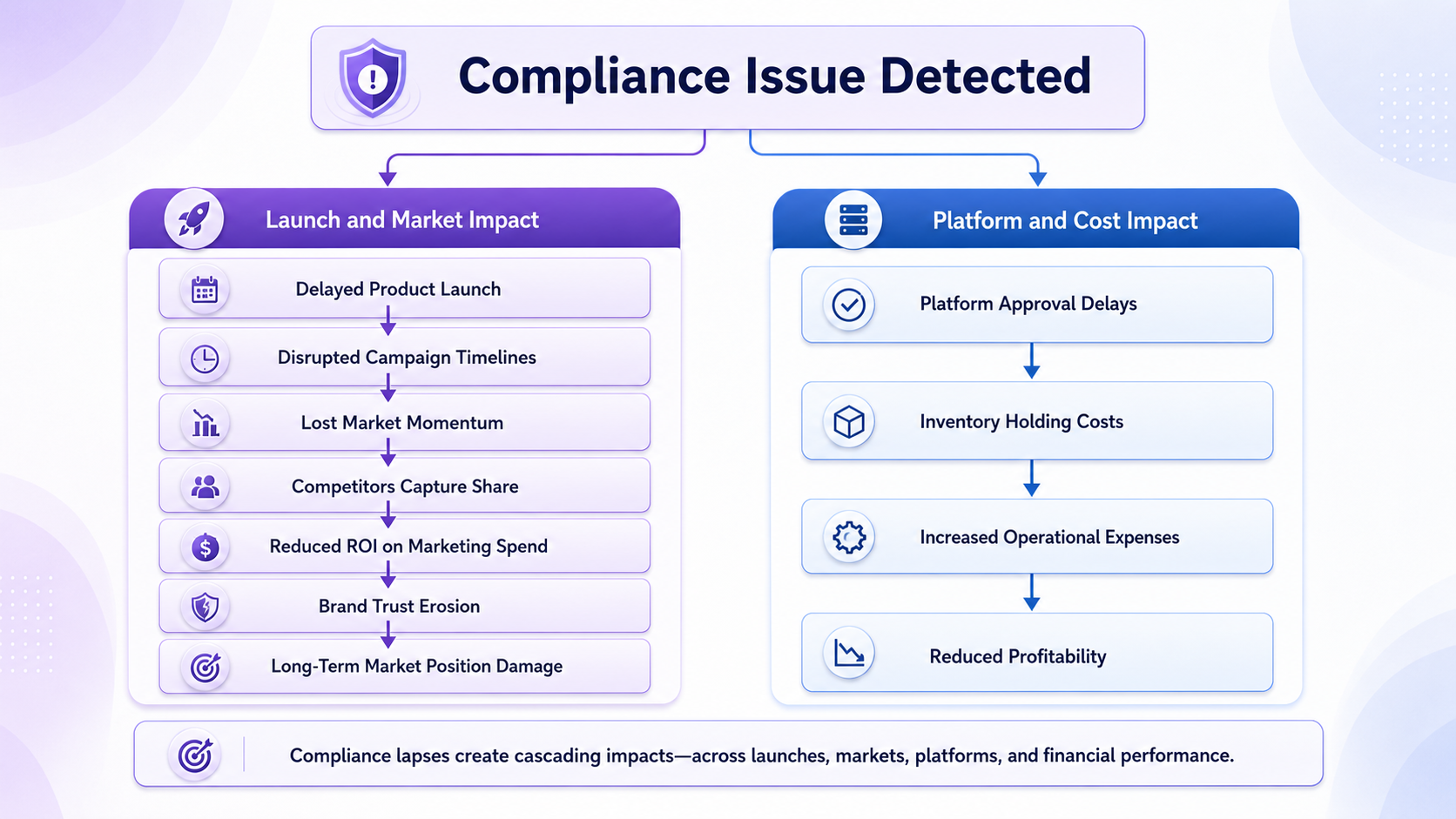 This diagram illustrates the cascading commercial impact of compliance failures.
For health supplement brands, the stakes are particularly high. Under China’s regulatory framework, health supplements using ingredients outside the approved raw materials list, as well as first-time imported health supplements (with the exception of those supplementing vitamins and minerals), must undergo registration with the State Administration for Market Regulation. First-time imported supplements that are limited to vitamins and minerals may be filed through a备案 (record-filing) process. Other health supplements must be registered with provincial-level food safety authorities, and imported products must be legally permitted for sale in their country of origin (State Administration for Market Regulation, 2025b). As of March 2025, there were 13,000 active health supplement registration certificates and 22,000 active record-filing certificates (State Administration for Market Regulation, 2025b).
In 2025, only 26 imported health supplement products successfully obtained record-filing certificates, a slight decrease from 28 in 2024 (State Administration for Market Regulation, 2026). This relatively small number underscores the rigour of the approval process and the importance of thorough preparation.
Compliance as a Trust Signal
An important shift has occurred over the past decade. Compliance is no longer viewed solely as a backend operational function. Increasingly, it contributes directly to consumer trust. Chinese consumers have become more informed and selective. Product transparency, ingredient sourcing, manufacturing standards, and certification requirements all influence purchasing decisions.
This is particularly true in categories such as health supplements, beauty and skincare, baby and maternity products, functional foods, and pet nutrition. Consumers want reassurance that products meet quality standards. As a result, regulatory readiness has become part of the broader trust-building process.
General Administration of Customs data confirms that imported consumer goods — beauty products, cosmetics, personal care items, food, and health supplements — continue to dominate cross-border e-commerce imports, accounting for 27.2% of all imports in 2025 (General Administration of Customs of China, 2026). However, the competition for consumer attention in these categories is intense. Brands that simply translate their existing marketing materials often struggle to gain traction. Brands that communicate transparency effectively often gain an advantage over competitors relying purely on promotional messaging.
The brands that perform best are often those that integrate regulatory planning into their overall market strategy from the beginning. They view compliance not as a hurdle to overcome but as a foundation for sustainable growth.
The Relationship Between Compliance and Market Entry
Many organisations view compliance as a checkpoint that occurs before launch. The reality is more interconnected. Regulatory considerations influence nearly every stage of market entry. They affect product selection. They influence packaging decisions. They impact content creation. They shape platform strategies. They determine operational workflows.
A product that performs well in one market may require modifications before entering China. Marketing claims that are acceptable elsewhere may need adjustment. Certain product categories may require additional preparation before commercialisation. When compliance teams and marketing teams operate independently, problems often emerge. When they work together, market entry becomes significantly smoother.
The CBEC Import Process Flowchart
This flowchart illustrates the end-to-end journey of a product through China’s CBEC system.
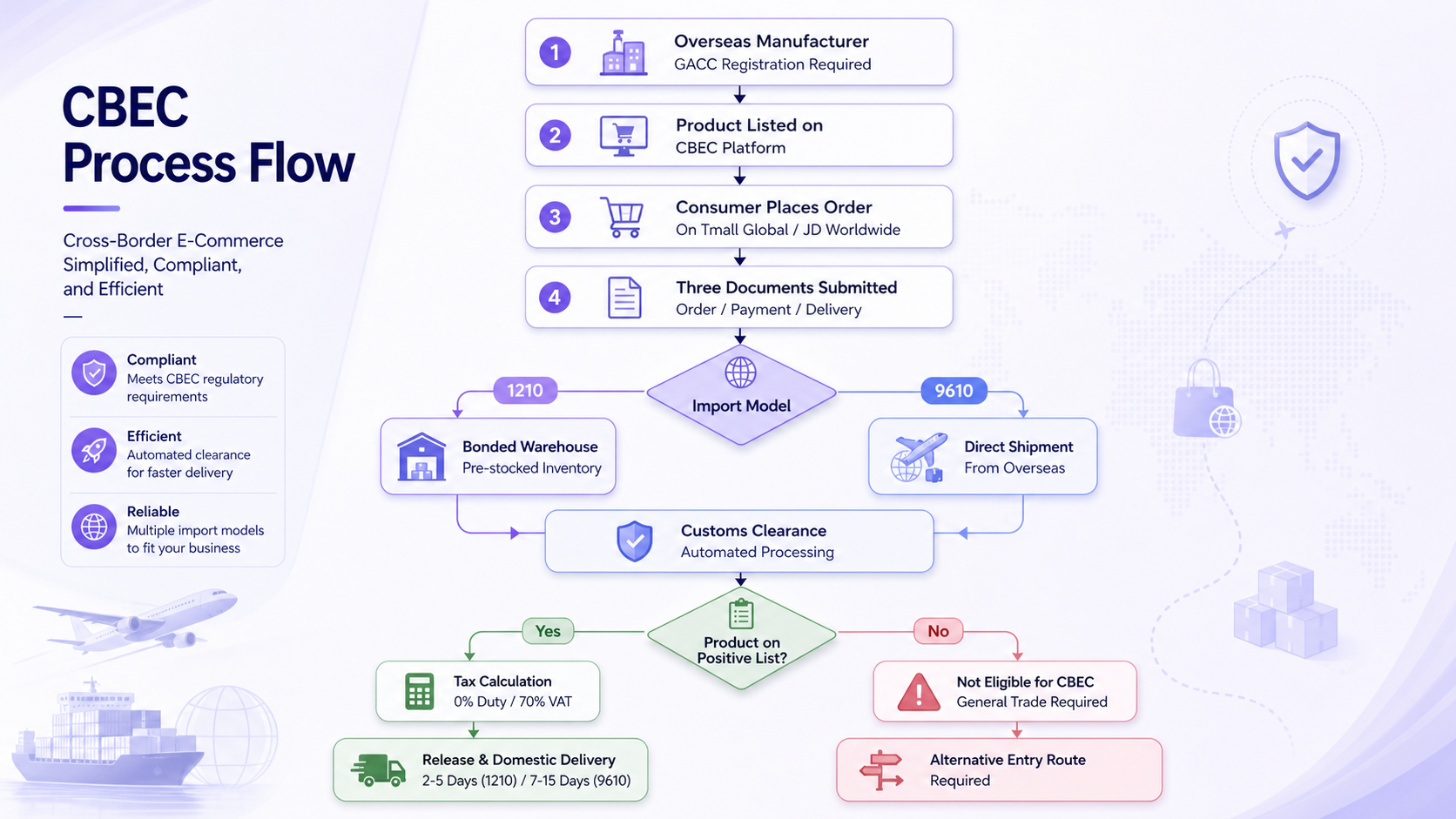
Data source: Lianyungang Development Zone Customs (2025); General Administration of Customs of China (2025)
For example, the cross-border e-commerce retail import positive list specifies which products may be imported through cross-border channels. The list, most recently updated in 2022, expanded to include 1,476 product categories, adding items such as skiing equipment, household dishwashers, and tomato juice in response to growing consumer demand (Hunan Provincial Department of Commerce, 2025). Products not on the positive list cannot be imported through cross-border e-commerce channels, regardless of consumer demand or brand reputation.
Cross-border e-commerce retail imports are subject to transaction limits. The single transaction limit is RMB 5,000, and the annual transaction limit is RMB 26,000 per consumer (Lianyungang Development Zone Customs, 2025). Within these limits, import tariffs are temporarily set at 0%, while value-added tax and consumption tax are levied at 70% of the statutory amount(Lianyungang Development Zone Customs, 2025). Products exceeding the annual limit must be imported through general trade channels, with significantly different compliance requirements.
What Successful Brands Do Differently
The strongest international brands rarely treat regulations as obstacles. Instead, they view compliance as part of strategic planning. Before investing heavily in advertising or influencer campaigns, they invest time understanding the regulatory environment surrounding their category. They ask questions early. They conduct assessments before launch. They work with local specialists. Most importantly, they recognise that regulatory readiness protects commercial investment.
A marketing budget can generate awareness. A great product can create demand. But sustainable growth requires both to operate within a compliant framework.
The Compliance-First Market Entry Framework
This diagram illustrates how successful brands integrate compliance throughout the market entry process.
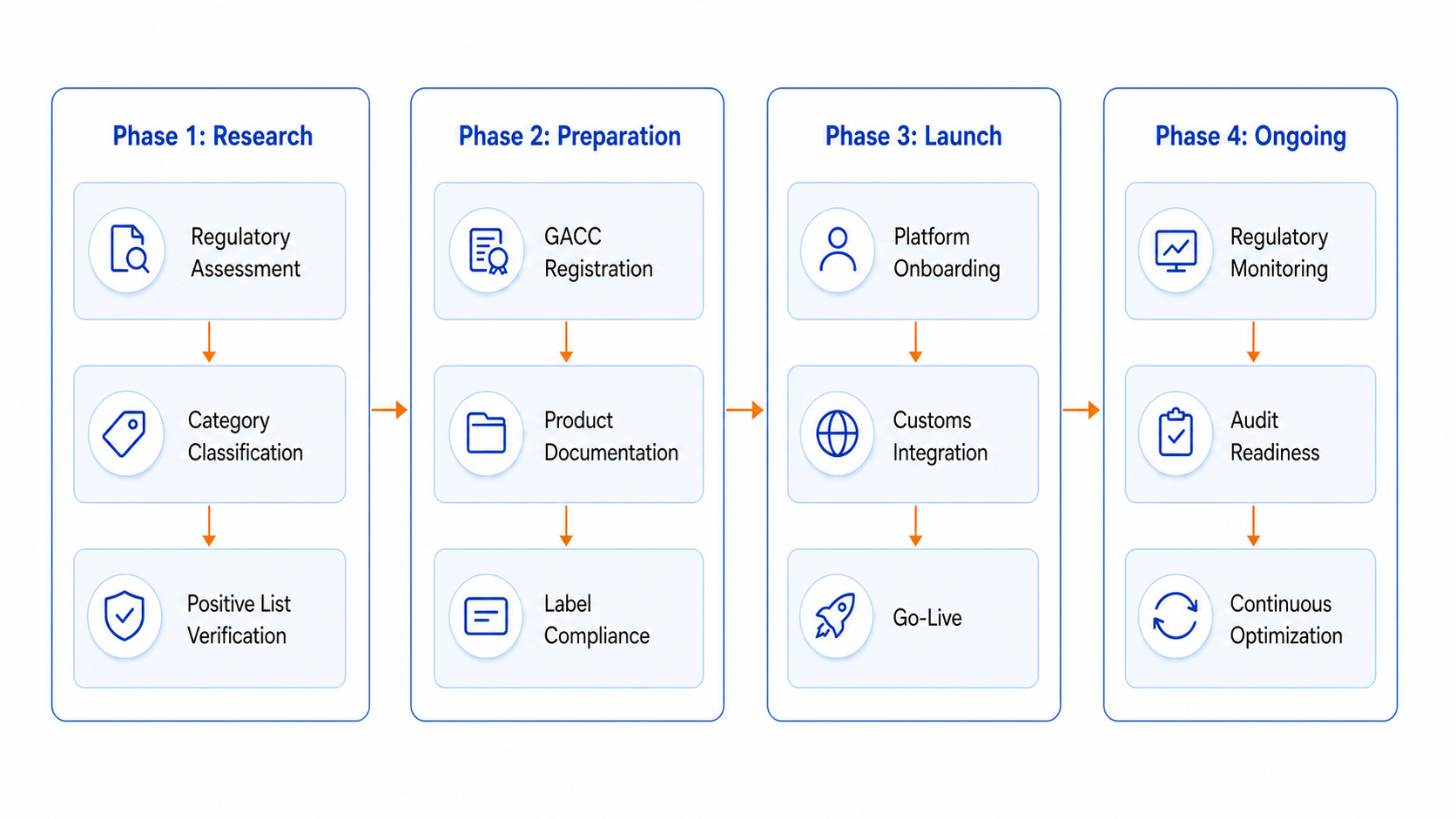 The brands that succeed treat compliance as a continuous process rather than a one-time exercise. They monitor regulatory changes. They adapt their operations accordingly. They build relationships with local partners who understand the nuances of China’s regulatory environment. And they recognise that in China’s evolving digital economy, regulatory agility is as important as commercial agility.
Looking Ahead
China’s cross-border e-commerce ecosystem continues to evolve. New technologies, shifting consumer expectations, and growing international participation will likely drive further regulatory refinement over the coming years. In 2026, cross-border trade facilitation measures continue to expand, including initiatives to optimise overseas warehouse supervision, support returns and tax refunds for cross-border e-commerce exports, and expand pilot programmes for “inspect first, then load” export consolidation (General Administration of Customs of China, 2026a).
For brands, this means compliance can no longer be treated as a one-time exercise. It requires ongoing monitoring and adaptation. The companies that succeed will not necessarily be those with the largest marketing budgets. They will be the organisations capable of combining consumer insight, operational excellence, and regulatory preparedness into a unified strategy.
CBEC Compliance Maturity Model
This maturity model helps brands assess their current compliance capabilities and identify areas for improvement.
| Maturity Level | Characteristics | Key Risks | Recommended Actions |
| Level 1: Ad Hoc | Reactive approach; compliance addressed only when issues arise | Launch delays, platform rejections, regulatory penalties | Conduct regulatory assessment; engage local compliance partner |
| Level 2: Foundational | Basic registration completed; key documentation in place | Gaps in category-specific requirements; evolving regulations | Implement compliance calendar; monitor regulatory updates |
| Level 3: Integrated | Compliance embedded in market entry planning | Cross-functional coordination gaps | Establish compliance-review process for all market activities |
| Level 4: Strategic | Compliance viewed as competitive advantage | Overconfidence; potential for complacency | Continuous monitoring; proactive regulatory engagement |
Final Thoughts
The biggest mistake many global brands make is viewing compliance as a hurdle to overcome rather than a foundation for growth. In reality, China’s cross-border regulations exist within a framework designed to support consumer confidence and market stability. Brands that understand this are often better positioned to launch efficiently, scale sustainably, and build long-term trust with Chinese consumers.
At MyMyPanda, we help international brands navigate both the commercial and operational realities of China’s cross-border e-commerce landscape, enabling businesses to enter the market with greater confidence and fewer surprises.
References
- (2025, December 13). 2026年中国跨境电商市场规模预测及行业发展的驱动因素分析(图). 中商情报网. https://big5.askci.com
- China Briefing. (2025, September 18). The probe into Dior’s PIPL violations: Key lessons for foreign businesses. https://www.china-briefing.com
- General Administration of Customs of China. (2025, November 24). 2025年上半年中国跨境电商进出口情况. http://dzs.customs.gov.cn
- General Administration of Customs of China. (2025b, April 30). 《海关总署关于明确跨境电商销毁退运有关事项的公告》的政策解读. http://www.customs.gov.cn
- General Administration of Customs of China. (2026, June 16). 2025年中国跨境电商进出口情况. http://dzs.customs.gov.cn
- General Administration of Customs of China. (2026b, March 12). 海关总署公告2026年第24号(关于全面推广跨境电商零售出口商品跨关区退货的公告). http://www.customs.gov.cn
- General Administration of Customs of China. (2026a, April 17). 2026年跨境贸易便利化专项行动政策措施解读(一). http://taiyuan.customs.gov.cn
- Hangzhou Shangcheng District. (2026, January 13). 跨境电商产业风控法务指引[Cross-Border E-Commerce Industry Risk Control Legal Guidelines]. https://www.gdte.org.cn[reference:14]
- Hunan Provincial Department of Commerce. (2025, December 31). 跨境电商零售进口知识干货集锦——助你成为跨境购物达人. http://ftz.hunan.gov.cn
- (2025, September 10). MNC in China receives administrative penalty for non-compliant cross-border personal information transfer. https://www.lexology.com
- Lianyungang Development Zone Customs. (2025, July 28). 海关科普 | 跨境电商热点问答. http://www.lda.gov.cn
- Ministry of Commerce. (2026, January 23). 商务部:2025年线上服务消费增长22% 重点跨境电商进口平台零售额增长6%. https://hk.investing.com
- Shanghai Jungle. (2026, April 7). Learn how CBEC works in China — bonded warehouses, tax advantages, platforms, and setup process. https://www.shanghaijungle.com
- State Administration for Market Regulation. (2025, September 9). 市场监管总局关于公开征求《市场监管总局 商务部关于进一步加强跨境电商零售进口食品召回监管的公告》意见的公告. http://www.samr.gov.cn
- State Administration for Market Regulation. (2025b, June 24). 对十四届全国人大三次会议第1202号建议的答复. http://www.samr.gov.cn
- State Administration for Market Regulation. (2026, January 9). 2025年终盘点-保健食品备案情况. http://www.samr.gov.cn