


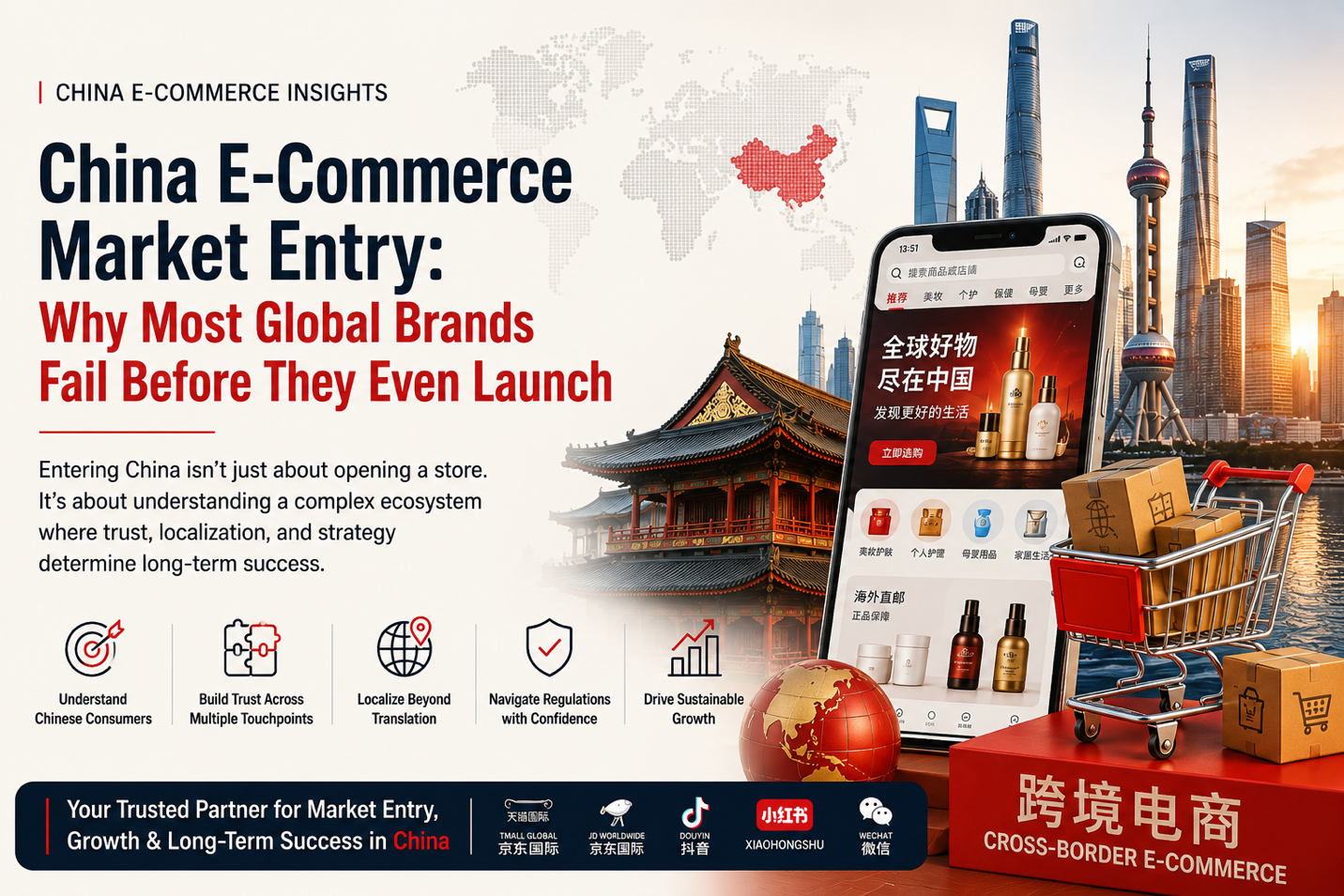
In early 2025, a European wellness brand entered China with high expectations. The company had spent nearly a year preparing. Its products were already successful in Germany, France, and the UK. The management team had approved a substantial marketing budget. Packaging had been localized. Logistics partners had been selected. Forecasts projected millions in annual sales within two years.
Twelve months later, the results were devastating.
The products attracted attention, but conversions remained stubbornly low. Customer acquisition costs were three times higher than expected. Social media engagement appeared healthy on paper, yet sales lagged far behind projections.
The brand had not failed because of product quality. It had failed because it misunderstood what a China e-commerce market entry strategy actually requires.
This story is not unique. According to Shanghai Jungle (2026), the failure rate for foreign brands entering China remains “staggeringly high.” Uni-World Service Co. (2025) puts the figure even more starkly: 70% of foreign brands fail within 18 months of entering the Chinese market. The reasons are seldom product-related. Instead, they lie in what Uni-World (2025) describes as “the invisible fissures of regulatory complexity, cultural nuance, and tax structures that most outsiders mistake for footnotes.”
The Scale of Opportunity
China’s digital economy continues to reshape global commerce at a scale that is difficult to comprehend from outside. According to the General Administration of Customs of China (2026), cross-border e-commerce imports and exports reached RMB 2.84 trillion (approximately USD 392 billion) in 2025, with imports accounting for RMB 570.2 billion. The total represents a 4.8% increase year-over-year, with both import and export volumes reaching record highs (General Administration of Customs of China, 2026).
In the first half of 2025 alone, cross-border e-commerce imports and exports reached RMB 1.37 trillion, growing 10.3% year-over-year and outpacing overall merchandise trade growth by 7.4 percentage points (General Administration of Customs of China, 2025). The United States remains the largest import source, accounting for 14.7% of all cross-border e-commerce imports, followed by Germany and Japan at 10.2% each (General Administration of Customs of China, 2025).
The broader e-commerce landscape is equally impressive. According to AskCI (2025), China’s cross-border e-commerce market grew from RMB 1.888 trillion in 2021 to RMB 3.257 trillion in 2024, with projections reaching RMB 3.813 trillion in 2025 and RMB 4.435 trillion in 2026. Cross-border e-commerce now accounts for 6.2% of China’s total merchandise trade, up 0.4 percentage points from the previous year (General Administration of Customs of China, 2026). Shanghai Jungle (2026) projects China’s annual online retail sales will reach USD 2.93 trillion in 2025, with over 900 million digital consumers.
For international brands, the opportunity is obvious. The challenge is that many companies still approach China using strategies that worked elsewhere. What succeeds in North America, Europe, or Southeast Asia often requires significant adaptation before it can succeed in China. Chinese consumers do not discover, evaluate, and purchase products in the same way as consumers in most Western markets.
The Most Common Strategic Error
Many companies view China as an extension of their existing international business. Their thinking typically follows a familiar pattern: a successful product, established brand positioning, and a need for local distribution. Chinese consumers, however, rarely see things that way.
As Shanghai Jungle (2026) observes, “The problem is rarely the product. It’s the process. Brands that fail typically share one thing in common: they approached China as an incremental expansion rather than a distinct strategic initiative requiring its own framework, budget, and timeline.” Uni-World (2025) elaborates: “This isn’t a market you simply ‘enter’; it’s a system you must decode.”
The firm cites the example of a well-funded European skincare brand that spent two years negotiating with Alibaba’s Tmall, only to discover their supply chain was hemorrhaging 22% in hidden cross-border VAT liabilities. Another U.S. direct-to-consumer startup replicated its Shopify model on JD.com, oblivious to China’s fapiao invoice system “until auditors came knocking” (Uni-World, 2025).
A skincare brand that succeeds through Google search and Instagram marketing may discover that neither channel plays a meaningful role in China. A supplement company with strong Amazon sales may find that Chinese consumers demand entirely different forms of trust validation before making a purchase. Market entry strategies built around assumptions rather than local consumer behavior often struggle from the outset.
Trust: The True Currency of Conversion
When discussing China e-commerce market entry, most conversations focus on traffic. How many users can a platform deliver? How many followers can a brand acquire? How many impressions can a campaign generate? These questions matter, but they rarely address the core issue. The real challenge is trust.
Chinese consumers are exposed to an enormous amount of information every day. They compare products, review ingredients, study user feedback, and actively research brands before purchasing. A consumer may discover a product on Douyin, research it on Xiaohongshu, verify reviews through social communities, compare pricing across marketplaces, and only then decide whether to buy. Visibility creates awareness; trust creates revenue.
Brands that understand this distinction tend to perform significantly better during their market entry phase. The General Administration of Customs of China (2026) data confirms that imported consumer goods remain in high demand, with beauty products, cosmetics, personal care items, food, and health supplements among the top categories. However, competition in these categories is fierce, and consumers have countless options.
The Ecosystem, Not the Platform
One of the first questions international brands ask is: “Which platform should we enter?” The answer is usually more complicated than expected. Tmall Global, JD Worldwide, Douyin, Xiaohongshu, and WeChat all serve different purposes within the customer journey. Many brands make the mistake of treating platforms as sales channels only. The most successful brands treat platforms as stages within a broader ecosystem.
Consider a typical customer journey. A consumer first discovers a product through content on Xiaohongshu. Several days later, they encounter creator recommendations on Douyin. They continue researching product reviews and user experiences. Eventually, they visit a marketplace to compare pricing and product information. Only after multiple interactions do they complete a purchase. The winning strategy is rarely about choosing one platform; it is about understanding how platforms work together.
According to data from 100EC (2026), “content platforms and e-commerce platforms are increasingly blurring boundaries, with ‘content as channel’ becoming a consensus.” The report notes that social media, short videos, and influencer recommendations have a significantly enhanced impact on consumer purchasing decisions (100EC, 2026). Shanghai Jungle (2026) emphasizes that successful brands treat China market entry as a structured project with clear phases, defined milestones, and realistic expectations. “They understand that ‘we’ll figure it out as we go’ is the most expensive strategy of all.”
The firm recommends a six-phase framework: research, legal setup, platform selection, content localization, launch execution, and post-launch optimization. The research phase alone — which includes market validation and competitor analysis — typically requires two months and a budget of USD 5,000–20,000.
Content as Commerce Infrastructure
A decade ago, success in e-commerce was largely determined by product listings, search rankings, and promotional activity. Today, content often influences purchasing decisions long before consumers reach a product page. This shift has been particularly significant in China.
According to 100EC (2026), “content platforms and e-commerce platforms are increasingly blurring boundaries.” Consumers no longer wait until they are ready to buy before researching products. They discover products through stories, recommendations, reviews, livestreams, and educational content. For international brands, this changes the role of marketing entirely. Marketing is no longer simply about promotion; it is about education. Brands that invest in explaining their products, demonstrating expertise, and building credibility often outperform competitors with larger advertising budgets.
The General Administration of Customs of China (2025) data confirms that imported consumer goods — particularly beauty products, cosmetics, and personal care items — continue to dominate cross-border e-commerce imports, accounting for 27.2% of all imports in 2025. However, the competition for consumer attention in these categories is intense. Brands that simply translate their existing marketing materials often struggle to gain traction.
The Depth of Localization
Many companies underestimate the importance of localization. Translating a website into Chinese is relatively easy. Adapting a brand to Chinese consumer expectations is far more complex. Successful market entry often requires adjustments to product positioning, content strategy, messaging, visual presentation, customer service, and community engagement.
The strongest international brands do not simply translate their existing marketing materials. They rethink how their products fit into local consumer conversations. This is particularly important on platforms such as Xiaohongshu, where consumers actively seek authentic recommendations rather than promotional messaging. Brands that fail to localize often appear disconnected from their audience. Brands that localize effectively appear relevant and trustworthy.
Shanghai Jungle (2026) notes that “the brands that succeed treat China market entry as a structured project with clear phases, defined milestones, and realistic expectations.” This includes investing in research before committing resources, registering trademarks before anyone in China knows their brand exists, and choosing partners based on capability rather than cost.
Regulatory Readiness as Competitive Advantage
Market opportunity and consumer demand mean little if compliance issues disrupt operations. China’s regulatory environment continues to evolve, particularly within cross-border e-commerce. Import requirements, product classifications, labeling standards, ingredient restrictions, and platform policies all influence market entry success.
According to 100EC (2026), “compliance has become a compulsory course” for brands operating in China. The report notes that data security, privacy protection, cross-border information flow rules are becoming increasingly strict, and requirements for product compliance, tax compliance, and environmental responsibility standards are rising. The General Administration of Customs of China (2025) data shows that the United States remains the largest source of cross-border e-commerce imports, accounting for 14.7% of all imports, followed by Germany and Japan at 10.2% each.
Many international brands focus heavily on marketing while underestimating operational readiness. The result is often delayed launches, marketplace restrictions, or unexpected compliance challenges. The most successful companies treat regulatory planning as a commercial advantage rather than an administrative requirement.
What Separates Success from Failure
After examining international brands entering China, a common pattern emerges. The strongest performers rarely win because they have the largest budgets. They win because they understand the market before they invest heavily in growth. They invest time in consumer research. They build trust before aggressively pursuing sales. They align content with consumer behavior. They understand the role of each platform. They treat localization as a strategic exercise rather than a translation project.
Most importantly, they recognize that China rewards patience. Brands looking for immediate results often become frustrated. Brands focused on long-term market development tend to build stronger foundations. As Shanghai Jungle (2026) notes: “In our experience working with foreign brands across categories, the ones that launch successfully almost always share three traits: they invest in research before committing resources, they register trademarks before anyone in China knows their brand exists, and they choose partners based on capability rather than cost.”
Looking Ahead
China’s e-commerce market remains one of the most attractive growth opportunities for international brands. The numbers are compelling: RMB 2.84 trillion in cross-border e-commerce trade in 2025, growing to an expected RMB 4.435 trillion by 2026 (AskCI, 2025; General Administration of Customs of China, 2026). However, the barriers to success are no longer primarily logistical or technological. The challenge today is understanding how Chinese consumers discover, evaluate, and trust brands.
As content-driven commerce, social recommendations, and community-led purchasing continue to influence decision-making, companies must rethink traditional market entry models. The future belongs to brands that understand not only how to sell in China, but how to build credibility within China’s unique digital ecosystem. A successful China e-commerce market entry strategy is not defined by platform selection alone. It is defined by a brand’s ability to earn trust, localize effectively, navigate regulations, and connect with consumers across multiple touchpoints.
At MyMyPanda, we help international brands navigate every stage of the China market entry journey—from platform selection and localization to content strategy, compliance support, and operational execution—helping brands turn market potential into sustainable growth.
References
- (2026, February 24). 盘点:中国跨境电商行业全景洞察与未来五年发展趋势. 网经社. https://imgs-b2b.100ec.cn
- (2025, December 13). 2026年中国跨境电商市场规模预测及行业发展的驱动因素分析(图). 中商情报网. https://big5.askci.com
- General Administration of Customs of China. (2025, November 24). 2025年上半年中国跨境电商进出口情况. 中华人民共和国海关总署. http://dzs.customs.gov.cn
- General Administration of Customs of China. (2026, June 16). 2025年中国跨境电商进出口情况. 中华人民共和国海关总署. http://www.customs.gov.cn
- Shanghai Jungle. (2026, March 22). China market entry strategy: A step-by-step framework for foreign brands. https://www.shanghaijungle.com
- Uni-World Service Co. (2025, May 10). Effective strategies for entering China e-commerce market and succeeding. https://uni-world.co