



When international health and food supplement brands prepare for a launch in China, the focus is almost always on consumer demand, platform selection, and marketing campaigns. Sales forecasts look promising, digital ads are primed, and influencers are ready to post.
Then, the campaign stalls.
The issue is rarely product quality, pricing, or consumer interest. It is compliance. A sudden regulatory intervention or a documentation mismatch can freeze marketplace approvals and disrupt promotional timelines overnight. By the time the issue is resolved, competitors have already captured the momentum the brand worked months to build.
Stories like this are becoming increasingly common. As Chinese authorities tighten food safety oversight for cross-border e-commerce (CBEC), understanding the shifting regulatory landscape is no longer a backend administrative chore—it is the difference between a successful market entry and a costly failure.
The Scale of the Opportunity vs. The Reality of the Regulatory Framework
China’s cross-border e-commerce ecosystem remains one of the largest and most dynamic digital trade markets in the world, with imported consumer goods, food, and health supplements continuing to account for a massive share of total import volume. For global brands, the appeal is obvious: CBEC lowers initial barriers to entry and provides direct access to hundreds of millions of digital-first consumers.
To contextualize the scale of this market:
- China’s online retail market reached RMB 15.97 trillion in 2025, growing 6% year on year (National Bureau of Statistics of China, 2025).
- Online retail sales of physical goods reached RMB 13.09 trillion, representing 1% of total retail consumer goods (National Bureau of Statistics of China, 2025).
- Customs data reported that China’s cross-border e-commerce imports and exports reached RMB 2.84 trillion in 2025, up 8% year on year (State Council Information Office / China Customs, 2025).
- In the first half of 2026 alone, around 140 million Chinese consumers made purchases through cross-border e-commerce platforms (State Council Information Office / China Customs, 2025).
However, lower barriers do not eliminate regulatory requirements; they simply change them. One of the most common misconceptions among foreign brands is the belief that cross-border e-commerce allows companies to bypass standard national standards. In reality, CBEC operates within a strictly structured framework where products must comply with platform rules, customs regulations, and category-specific safety mandates. Problems arise when international companies attempt to apply assumptions from their home markets directly to China’s unique regulatory environment.
This is why China e-commerce market entry should not begin with launching a store. It should begin with testing whether the brand, product, and operating model are ready for Chinese consumers—and, crucially, for Chinese regulators.
High-Level Joint Enforcements and Platform Accountability
Regulatory oversight has shifted from isolated checks to coordinated, multi-agency enforcement. In a landmark joint administrative action, the State Council’s Food Safety Office, the State Administration for Market Regulation (SAMR), and the General Administration of Customs (GAC) summoned major platforms including Douyin, Taobao/Tmall, and Xiaohongshu.
This high-profile intervention was triggered by media and consumer exposures regarding marketing irregularities and origin compliance issues tied to imported health products, such as the Australian brand “Usis (优思益).” Authorities made it clear during these talks that platforms must strictly enforce compliance under China’s Food Safety Law, Consumer Protection Law, and Anti-Unfair Competition Law.
This sweeping move establishes a clear precedent: tech giants and e-commerce platforms are now held directly accountable for vetting, monitoring, and purging non-compliant goods from their merchant ecosystems. For international brands, this means that platform selection is no longer just a commercial decision—it is a compliance decision. A CBEC platform should not be evaluated separately from China’s regulatory environment.
At the same time, regulators are refining the CBEC framework itself. In late 2025, China’s legislature suggested optimizing CBEC regulatory policies to address emerging food safety risks, including introducing a negative list for imported CBEC foods and clarifying food recall responsibilities. In early 2026, SAMR and the Ministry of Commerce issued new rules expressly including CBEC foods in the national food recall framework and requiring overseas CBEC food businesses to appoint a domestic entity in mainland China to manage and execute product recalls.
Platform Governance: Raising the Bar on Content and Product Standards
To mitigate regulatory exposure and align with government mandates, major e-commerce platforms have systematically updated their internal governance rules. Ecosystems like Xiaohongshu have rolled out explicit regulatory frameworks (such as detailed operational and rule updates under rules sections 17 and 18) to crack down on unverified health claims, misleading product efficacy statements, and irregular cross-border sourcing practices.
Merchants can no longer rely on ambiguous marketing copy or unverified origin narratives. Under these tightened platform guidelines, any listing that lacks proper customs clearance documentation, misrepresents product origins, or fails to adhere to strict advertising standards faces immediate penalties, traffic restrictions, or store suspension.
For health supplements and functional foods, advertising rules are particularly strict. SAMR requires that health food advertisements be based on the content of the registration or filing certificate and approved product manual, must not claim disease prevention or treatment functions, and must prominently state that “health food is not a drug and cannot replace drugs for treating diseases,” along with displaying the health food logo and approval number where applicable.
Moreover, recent policy updates have heavily reinforced proper inventory and bonded-warehouse management. The General Administration of Customs issued strict measures covering the disposal of bonded imported goods that cannot be returned or sold—including food and supplement products affected by expiry, packaging damage, or recalls (General Administration of Customs of China, 2025). This underscores that compliance does not end once the product crosses customs or enters a warehouse; full lifecycle tracking and rigorous partner infrastructure are critical to avoiding operational disruptions (General Administration of Customs of China, 2025).
For food and supplement brands, this is especially important. China’s GACC Order 280 introduced updated registration rules for overseas food manufacturers from June 1, 2026, while CBEC products currently operate under a different framework from traditional general-trade imports (USDA FAS, 2025; China-Briefing, 2026). That is why compliance should be considered before scaling rather than after problems appear.
Under Decree 280, CBEC retail imports are currently treated as personal-use items and are generally exempt from the new overseas manufacturer registration requirements, which apply primarily to cargo-form general-trade imports (China-Briefing, 2026; MyMyPanda, 2026). However, the regulation explicitly states that CBEC requirements “shall be handled in accordance with relevant provisions,” leaving room for future tightening (USDA FAS, 2025).
Traditional CBEC vs. The New Compliance Era
To navigate this transition effectively, brands must understand the fundamental differences between legacy operating models and current regulatory expectations:
Evaluation Criteria
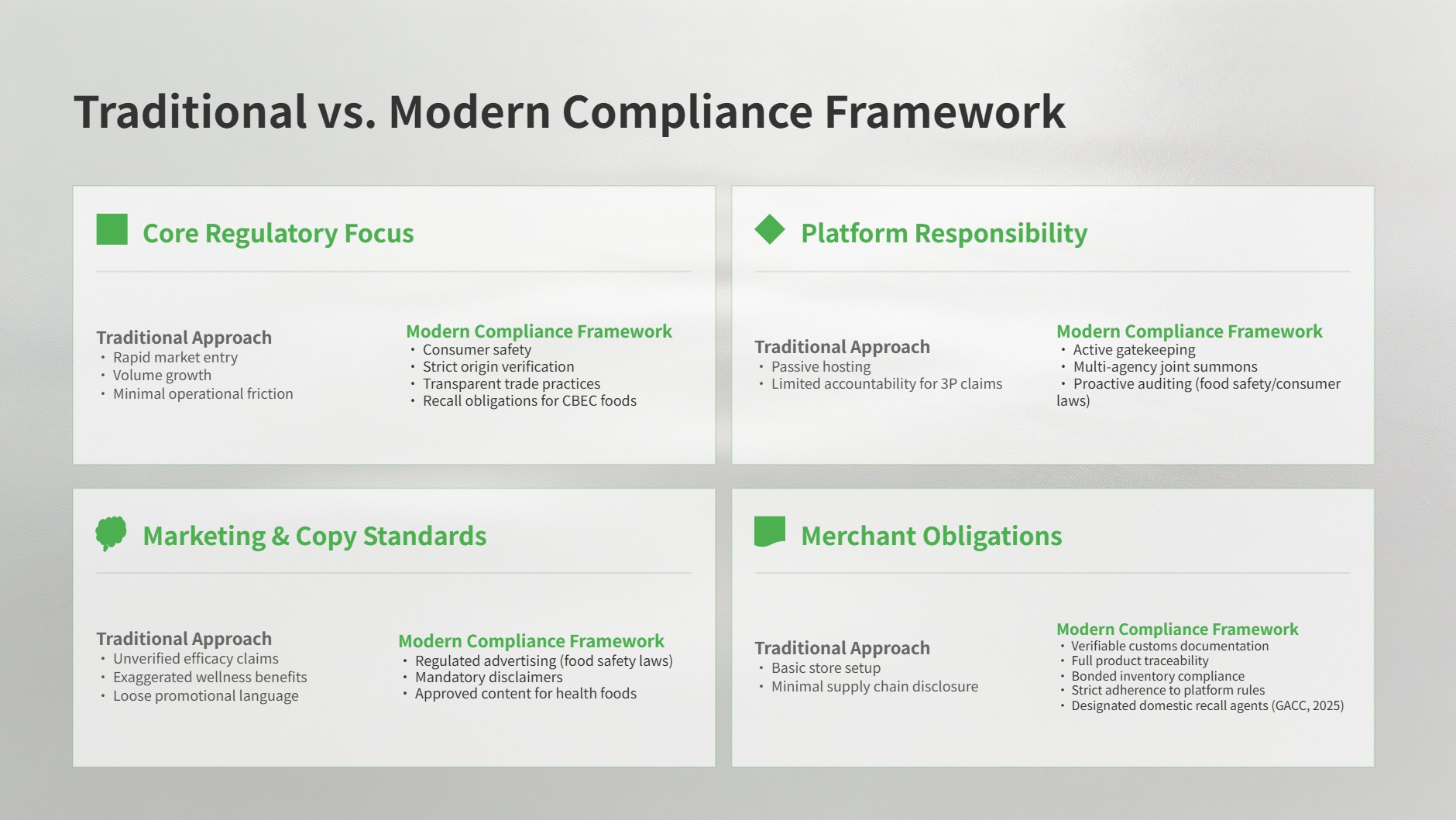
Core Regulatory Focus
- Traditional Approach (The Old Way): Rapid market entry, volume growth, and minimal operational friction.
- Modern Compliance Framework (Today): Consumer safety, strict origin verification, and transparent trade practices, including explicit recall obligations for CBEC foods.
Platform Responsibility
- Traditional: Passive hosting with limited accountability for third-party merchant claims.
- Modern: Active gatekeeping, direct multi-agency joint summons, and proactive auditing under food safety and consumer protection laws.
Marketing & Copy Standards
- Traditional: Unverified efficacy claims, exaggerated wellness benefits, and loose promotional language.
- Modern: Strictly regulated advertising adhering to food safety and consumer protection laws, with mandatory disclaimers and approved content for health foods.
Merchant Obligations
- Traditional: Basic store setup with minimal supply chain disclosure.
- Modern: Verifiable customs documentation, full product traceability, bonded inventory compliance, strict adherence to platform rules, and designated domestic recall agents for CBEC food operators (General Administration of Customs of China, 2025).
This shift mirrors a broader change in how brands should think about China market entry. Instead of treating it as a single launch event, the smarter approach is iterative: Test → Measure → Improve → Scale. Compliance is part of that loop, not a one-off checklist before go-live.
Why Compliance Fails in Practice (Even for Sophisticated Brands)
Most compliance failures do not come from malicious intent. They come from structural blind spots:
- Assuming “CBEC = no rules.” Many brands treat CBEC as a regulatory shortcut rather than a distinct import channel with its own requirements for documentation, product categories, and bonded inventory. While some requirements (like GACC manufacturer registration under Decree 280) currently exempt CBEC retail, other rules—especially on recalls and advertising—apply fully.
- Relying on translated materials only. Product claims, labels, and marketing copy that work in other markets often breach China’s advertising and food-safety rules when directly translated, particularly for health supplements that require SAMR-approved advertisement content.
- Fragmented infrastructure. When payments, customs, logistics, and customer service are handled by disconnected providers, it becomes difficult to maintain end-to-end traceability and respond quickly to regulatory queries or recall notices.
- Late compliance checks. Waiting until after marketing investment to validate whether a product can legally be sold under the intended CBEC model is a common and expensive mistake, especially given evolving rules on CBEC food recalls and potential future changes to the CBEC exemption under Decree 280.
The brands that succeed are those that treat compliance as part of the customer journey: from discovery to purchase to post-sale support and returns. A smooth operational and regulatory experience can allow a brand to focus more heavily on demand generation and customer acquisition.
Turning Compliance into a Strategic Advantage
While these enhanced regulations present operational challenges for brands accustomed to a more lenient environment, they ultimately foster a healthier, more transparent market.
As non-compliant operators are filtered out, brands that prioritize authentic sourcing, rigorous supply chain transparency, and full legal compliance are well-positioned to earn the trust of discerning Chinese consumers. Aligning operations with local regulatory expectations protects brand equity and secures a stable foundation for growth in the world’s most dynamic e-commerce market.
In practical terms, this means:
- Designing your China readiness assessment around compliance as well as demand: Is there genuine demand? Which segment? And can the product be sold through the intended CBEC model under current recall, advertising, and customs rules?
- Choosing a cross-border e-commerce partner that can explain how the relevant process works for your specific product category, including recall responsibilities, advertising approvals, and how Decree 280 may affect you if you later expand into general trade (USDA FAS, 2025; China-Briefing, 2026).
- Building infrastructure that connects commerce, compliance, logistics, payments, localisation, and market intelligence into one operating model, rather than a patchwork of vendors.
The strongest CBEC partners are not simply helping international businesses put products in front of Chinese consumers. They are helping connect these elements into a coherent growth engine.
From First Sale to Long-Term China Strategy
China should not be viewed as a market where an international brand must immediately build everything from the ground up. For many companies, a smarter approach is to establish a structured CBEC presence, validate demand, understand customer behaviour, and gradually build the infrastructure required for the next stage.
The first sale answers one question: Will someone buy?
The next hundred sales can answer much more important questions: Why did they buy? What should we change? What should we scale?
That is where cross-border e-commerce moves beyond being simply a route to market. It becomes a market intelligence and growth engine—but only if compliance and operational integrity are baked in from day one.
For international brands considering China, the opportunity is no longer just about finding a way into the market. It is about creating a system that allows the business to enter intelligently, learn quickly, and scale with confidence, without being derailed by preventable regulatory setbacks.
Ready to Safeguard Your Cross-Border Business?
Navigating China’s evolving regulatory requirements demands deep local expertise and proactive compliance strategies. Ensure your brand is fully protected against regulatory and platform risks.
At MyMyPanda, we support international brands in navigating both the commercial and operational complexities of China’s cross-border e-commerce landscape, helping them enter the market with greater confidence and fewer surprises.
References
- National Bureau of Statistics of China. (2025). 2025 retail and online retail data. https://www.stats.gov.cn/english/PressRelease/202601/t20260120_1962354.html
- State Council Information Office / China Customs. (2025). 2025 cross-border e-commerce data. https://english.scio.gov.cn/pressroom/2026-01/28/content_118304543_10.html
- (2026). Existing CBEC platform and market-entry content. https://www.mymypanda.com/mymypanda-china-launches-cross-border-e-commerce/
- General Administration of Customs of China. (2025). Bonded CBEC inventory and disposal regulations.
- USDA Foreign Agricultural Service (FAS). (2025). China: Decree 280 – GACC Update to Overseas Food Facility Registration. https://www.fas.usda.gov/data/china-decree-280-gacc-update-overseas-food-facility-registration
- China-Briefing. (2026). GAC Overseas Food Manufacturer Registration: A Guide. https://www.china-briefing.com/news/gac-overseas-food-manufacturer-registration-china-new-rules-2026/
- Ministry of Justice of China. (2026). 国务院食安办 市场监管总局 海关总署约谈 3 家平台企业。http://legalinfo.moj.gov.cn/zhfxfzzx/fzzxyw/202604/t20260403_533478.html
- China Daily. (2026). 国务院食安办 市场监管总局 海关总署约谈 3 家平台企业https://cn.chinadaily.com.cn/a/202604/03/WS69cef6c5a310942cc49a644c.html
- Xinhua / News.cn. (2026). 网红产品“澳洲优思益”被曝涉嫌产地造假 多部门展开调查 约谈三家平台企业 https://www.news.cn/health/20260403/72762de3dd1849f99a3f2fd44d9a85a8/c.html