For global brands entering China, influencer marketing is no longer simply about finding the person with the biggest following.
China has developed a creator ecosystem that is considerably more layered than the traditional celebrity-influencer model familiar to many Western marketers. Brands can work with celebrity-level Key Opinion Leaders (KOLs), mid-tier creators, niche experts, Key Opinion Consumers (KOCs), and ordinary users whose product experiences become part of the wider conversation.
The distinction matters.
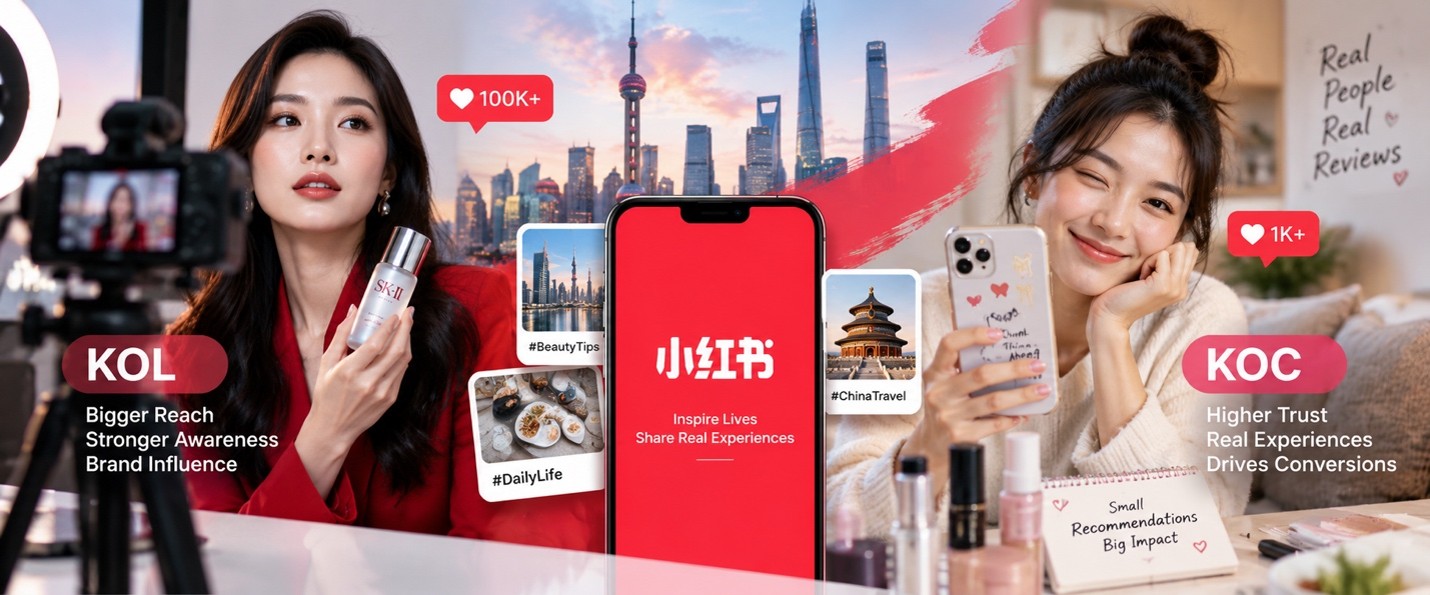
A KOL can put a new product in front of millions of consumers. A KOC can make that same product feel like a recommendation from someone the consumer actually trusts.
This is particularly important in China, where social content and commerce are increasingly connected. McKinsey describes KOL and KOC activity as a core part of several Chinese social-commerce models, including social-first commerce and social DTC (McKinsey & Company, n.d.).
For international brands, the question is therefore not simply “KOL or KOC?”
The better question is:
Which combination of creators can move Chinese consumers from discovery to consideration and, ultimately, purchase?
What Are KOLs and KOCs?
Although the terms are often used together, KOLs and KOCs perform different roles within China’s digital ecosystem.
Key Opinion Leaders (KOLs)
KOLs are influential creators with established audiences and strong authority within a particular category.
They may include:
- Celebrity influencers
- Beauty experts
- Fashion creators
- Professional reviewers
- Lifestyle creators
- Industry specialists
- High-profile livestreamers
Their greatest strength is reach and visibility.
When a recognised creator introduces a product, a brand can quickly gain awareness among a large and highly targeted audience.
However, large reach does not automatically mean strong conversion.
The audience may recognise the creator without necessarily believing that the creator personally uses or recommends every product they promote.
What Are KOCs?
Key Opinion Consumers, or KOCs, operate differently.
Rather than building their influence primarily around celebrity status, KOCs typically share personal experiences, product reviews, recommendations, tutorials and everyday use cases.
Their audiences are generally smaller, but their content can feel considerably more personal.
A KOC might post:
- A skincare routine
- A restaurant recommendation
- An unboxing
- A product comparison
- A before-and-after experience
- A travel recommendation
- A personal review
The strength of this approach is relatability.
Research examining KOC behaviour on Chinese social-commerce platforms found that KOC performance directly influences customer trust and diminishes perceived risk to drive purchase intention (Hoang et al., 2024).
In other words, consumers are not only asking:
“Who is recommending this?”
They are also asking:
“Does this recommendation feel genuine?”
KOL vs. KOC: What Is the Difference?
| Factor | KOL | KOC |
| Audience size | Larger | Smaller |
| Primary strength | Reach & awareness | Trust & relatability |
| Content | Professional / polished | Personal / experience-driven |
| Cost | Generally higher | Generally lower |
| Brand awareness | Strong | Moderate |
| Social proof | Strong | Strong through peer experience |
| Best for | Launches & awareness | Reviews & consideration |
| Content volume | Lower | Higher |
| Conversion role | Creates attention | Reinforces purchase confidence |
The distinction is not absolute. A successful campaign may involve creators across several levels rather than placing all the budget into one category.
Why KOCs Matter in China
China’s social-commerce environment has made peer recommendation particularly valuable.
On platforms such as Xiaohongshu, users do not simply consume entertainment. They also search for experiences, reviews, comparisons and recommendations before making purchasing decisions.
This creates an important opportunity for KOCs.
A brand may receive significant exposure from one major creator, but dozens or hundreds of smaller creators can create a much wider layer of social proof around the product.
This is why the modern creator strategy increasingly looks less like:
One influencer → one campaign
and more like:
Multiple creators → multiple experiences → wider trust → stronger consideration.
Recent industry research also points towards a more decentralised creator ecosystem in China’s social commerce market, with creators increasingly contributing to engagement and conversion beyond traditional celebrity-led campaigns (NIQ, 2026).
When Should a Brand Use KOLs?
KOLs are particularly effective when the primary objective is rapid awareness.
For example, an international beauty brand entering China may want to introduce a new product line to a large audience within a short period.
A suitable KOL can help the brand:
- Generate immediate visibility
- Establish category credibility
- Create campaign momentum
- Introduce a new product
- Drive traffic to a platform or store
- Create content that can be amplified elsewhere
However, brands should avoid choosing creators based purely on follower count.
A creator with 2 million followers is not necessarily more valuable than one with 200,000 highly relevant followers.
The real question is whether the creator’s audience, content style and credibility match the brand.
When Should a Brand Use KOCs?
KOCs become particularly valuable when the objective shifts from awareness to consideration and trust.
For example, a consumer considering a new skincare product may see a KOL campaign first.
But before purchasing, they may search Xiaohongshu for:
- Real user reviews
- Skin-type experiences
- Product comparisons
- Unboxing videos
- Application tutorials
- Before-and-after results
- Alternative recommendations
This is where KOC content can become extremely powerful.
Instead of hearing one person say:
“This product is excellent.”
Consumers can find multiple independent-looking experiences showing how the product works in different situations.
That repetition can strengthen confidence.
The Most Effective Strategy: Use Both
The biggest mistake brands make is treating KOL and KOC marketing as competing strategies.
They are better understood as different stages of the same customer journey.
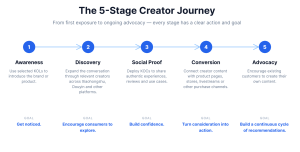
A strong campaign can work like this:
Stage 1 — Awareness
Use selected KOLs to introduce the brand or product.
Goal: Get noticed.
Stage 2 — Discovery
Expand the conversation through relevant creators across Xiaohongshu, Douyin and other platforms.
Goal: Encourage consumers to explore.
Stage 3 — Social Proof
Deploy KOCs to share authentic experiences, reviews and use cases.
Goal: Build confidence.
Stage 4 — Conversion
Connect creator content with product pages, stores, livestreams or other purchase channels.
Goal: Turn consideration into action.
Stage 5 — Advocacy
Encourage existing customers to create their own content.
Goal: Build a continuous cycle of recommendations.
This creates a much stronger ecosystem than relying on a single influencer.
Xiaohongshu: Where KOL and KOC Strategies Come Together
Xiaohongshu is particularly important for this approach because the platform sits at the intersection of content discovery, search, recommendations and commerce.
Industry analysis describes Xiaohongshu as an important consumer decision-making platform where KOL and KOC content helps users evaluate products and make purchasing decisions. (China Culture and Entertainment Industry Association [CCEA], 2023; Duan et al., 2019).
For international brands, this means influencer activity should not be viewed simply as advertising.
It can also contribute to the searchable content environment surrounding the brand.
A consumer may encounter a KOL post today, search the brand tomorrow, and discover multiple KOC reviews several days later.
The individual posts therefore become connected pieces of the same consumer journey.
Choosing the Right Creator
Follower count should never be the only selection criterion.
Brands should evaluate:
-
Audience relevance: Does the creator reach the people the brand actually wants to sell to?
-
Content quality: Does the creator produce content that feels natural on the platform?
-
Engagement: Are people actually interacting with the content?
-
Category expertise: Does the creator have credibility in the relevant category?
-
Audience sentiment: Are comments positive, meaningful and relevant?
-
Previous brand collaborations: Does the creator regularly promote unrelated products? Too many commercial collaborations can reduce perceived authenticity.
-
Conversion potential: Ultimately, the most important question is: Can this creator influence behaviour, not simply generate impressions?
Common Mistakes Western Brands Make
One of the biggest mistakes is copying an influencer strategy from Instagram, YouTube or TikTok and applying it directly to China.
The Chinese ecosystem operates differently.
Brands need to consider:
- Platform-specific content behaviour
- KOL and KOC structures
- Chinese consumer expectations
- Local content formats
- Cultural context
- Search behaviour
- Social commerce
- Livestreaming
- Local campaign management
China’s social-commerce ecosystem integrates content, creators and transactions much more closely than many traditional Western social strategies (McKinsey & Company, n.d.).
How Global Brands Can Build a Better KOL/KOC Strategy
A practical strategy should start with the business objective.
If the objective is awareness, prioritise reach.
If the objective is trust, prioritise authenticity.
If the objective is conversion, focus on creators with proven influence over purchasing decisions.
And if the objective is long-term growth, combine all three.
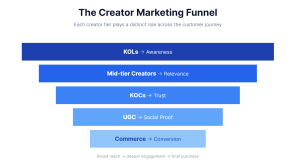
A balanced campaign could therefore include:
KOLs → awareness
Mid-tier creators → relevance
KOCs → trust
UGC → social proof
Commerce → conversion
This creates a connected ecosystem rather than a one-off influencer campaign.
How MyMyPanda Can Help
For international brands, building a creator network in China can be difficult without local knowledge.
MyMyPanda can support brands with the wider China market-entry and marketing process, including platform strategy, localization, influencer marketing and cross-border e-commerce execution.
The objective is not simply to find a creator.
It is to find the right creator for the right audience, platform and stage of the customer journey.
Final Thoughts
China’s influencer ecosystem is no longer a simple choice between celebrity marketing and traditional advertising.
KOLs can create awareness.
KOCs can create trust.
And when the two work together, brands can build a much stronger path from discovery to purchase.
For global brands entering China, the winning strategy is therefore not to ask:
“How many followers can we reach?”
It is to ask:
“How many relevant consumers can we convince?”
That shift—from reach to influence—is what makes KOL and KOC marketing such a powerful part of China’s social-commerce ecosystem.
References
Duan, Y., Wang, X., & Yang, J. (2019). Understanding consumer engagement and social commerce adoption on Chinese review platforms. Journal of Retailing and Consumer Services, 49(2), 112–124. https://doi.org/10.1016/j.jretconser.2019.03.004
Hoang, T. M., Nguyen, H. T., & Tran, Q. A. (2024). Impacts of Key Opinion Consumers on customer trust through perceived risk of Xiaohongshu users in Shanghai, China. ResearchGate [Preprint/Working Paper]. https://www.researchgate.net/publication/383647660_Impacts_of_Key_Opinion_Consumers_on_Customer_Trust_through_Perceived_Risk_of_Xiaohongshu_users_in_Shanghai_China
McKinsey & Company. (n.d.). China consumer report: Navigating the new landscape of digital commerce. McKinsey & Company.
NIQ. (2026). The commerce revolution: Where East meets West. NielsenIQ. https://investors.nielseniq.com/news/news-details/2026/Chinas-Commerce-Innovation-Is-Reshaping-Global-Retail/default.aspx