



A brand can spend a year preparing to enter China and still discover, within weeks of launch, that it prepared for the wrong things.
The product may be strong. The international website may already generate sales. The brand may have an established social media presence and a successful distribution network in other markets.
Yet China can expose gaps that are easy to overlook: product-market fit, localisation, payment preferences, fulfilment, consumer trust, compliance and the path from discovery to purchase.
That is why China e-commerce market entry should not begin with launching a store.
It should begin with testing whether the brand, product and operating model are ready for Chinese consumers.
The opportunity remains significant. In 2025, China’s total retail sales of consumer goods reached RMB 50.12 trillion, while online retail sales reached RMB 15.97 trillion, an 8.6% increase year on year. Online sales of physical goods alone reached RMB 13.09 trillion, equivalent to 26.1% of total retail sales of consumer goods. (National Bureau of Statistics of China)
China’s cross-border e-commerce sector is also continuing to expand. Preliminary customs data reported by China’s State Council Information Office put cross-border e-commerce imports and exports at RMB 2.75 trillion in 2025, 69.7% higher than in 2020. (State Council Information Office)
The question for international brands, therefore, is not simply whether China is attractive.
It is how to enter without committing too much capital before the market has validated the opportunity.
A 90-day approach can provide a practical starting point.
Days 1–30: Validate the Market Before You Scale
The first month should be about evidence, not expansion.
One of the most common mistakes international brands make is assuming that success in another market will automatically translate into China.
It does not.
Chinese consumers have their own expectations around product information, trust, pricing, content and purchasing experience. Even international brands that have strong global recognition need to understand how their proposition will be perceived locally.
McKinsey’s research on China’s consumer market has also highlighted an important shift: despite a more challenging macroeconomic environment, foreign brands continue to find opportunities in China when they align with evolving consumer demand. (McKinsey & Company)
Start with five questions
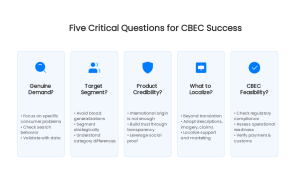
Before investing heavily in a China e-commerce launch, establish:
- Is there genuine demand for the product?
Look beyond broad category demand. Identify the specific consumer problem the product solves and whether Chinese consumers are already searching for comparable products.
- Which consumer segment should be targeted first?
“Chinese consumers” is far too broad a target audience.
A premium skincare product, for example, may need a completely different entry strategy from a health supplement or specialist food product.
- What makes the product credible?
International origin can be an advantage, but it is not enough on its own. Consumers need reasons to trust the product, understand its quality and believe that the brand can deliver reliably.
- What needs to be localised?
Translation is only the starting point.
Product descriptions, imagery, claims, pricing, customer support and marketing messages may all require adaptation.
- Can the product be sold through the intended CBEC model?
Regulatory and operational feasibility should be established before marketing investment begins.
This first stage is effectively a China readiness assessment.
The objective is not to generate millions in sales.
It is to discover whether the business model makes sense before scaling it.
Days 31–60: Build the China-Ready Commerce Infrastructure
Once demand and feasibility have been validated, the second stage is about building the infrastructure required to convert that demand into transactions.
This is where many market-entry plans become unnecessarily complicated.
An international brand may immediately consider establishing a local company, building physical distribution, hiring a large local team and committing to multiple marketplaces.
That may eventually be appropriate.
It does not necessarily need to happen on day one.
Cross-border e-commerce can provide international brands with an alternative route to test Chinese demand before committing to a more extensive local structure.
MyMyPanda’s own CBEC platform, for example, was designed around connecting overseas brands with Chinese consumers through localised payments, customs processes, logistics and fulfilment. (My My Panda)
The infrastructure should answer six practical questions
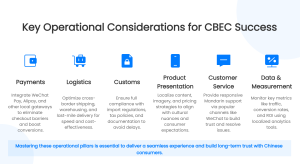
Payments:
Can Chinese consumers complete transactions using familiar local payment methods?
Logistics:
How will products move from the brand’s existing warehouse or a bonded facility to the customer?
Customs:
What documentation, product information and procedures are required?
Product presentation:
Does the Chinese customer see a properly localised product page rather than a translated version of an international website?
Customer service:
Can customers receive support in the language and channels they expect?
Data and measurement:
Can the brand identify where visitors are coming from, what they are viewing and which activities are generating commercial interest?
The objective of this stage is simple:
Remove friction between discovering the brand and completing the purchase.
Days 61–90: Launch, Measure and Learn
The third month should not be treated as the end of the market-entry process.
It is the beginning of the validation cycle.
Instead of immediately measuring success purely through revenue, brands should establish a broader set of commercial and behavioural metrics.
For example:
- Organic traffic from China
- Non-branded search clicks
- Product-page engagement
- Add-to-cart activity
- Conversion rate
- Lead enquiries
- Cost per acquisition
- Repeat visits
- Customer acquisition source
- Performance by product category
- Performance by marketing channel
This matters because a new market rarely produces a perfectly optimised customer journey immediately.
A campaign might generate strong traffic but weak conversion.
A product page might convert well but receive insufficient traffic.
A particular product may attract significant attention while another receives almost none.
These signals help determine what should be scaled and what should be changed.
The Market-Entry Decision Should Come After the Data
At the end of the first 90 days, an international brand should be able to make a much more informed decision.
There are essentially three possible outcomes.
- The market shows strong potential
If traffic, engagement, enquiries and transactions are developing positively, the next step can be increased investment.
That could mean expanding the product range, increasing marketing activity, working with local creators or expanding fulfilment capacity.
- The market shows interest but conversion is weak
This is not necessarily a failure.
It may indicate that the product is relevant but the customer journey needs improvement.
Pricing, product positioning, trust signals, content, payment options or localisation may need to be adjusted.
- The market shows limited demand
This is valuable information too.
It is considerably better to discover this after a controlled market test than after investing heavily in a full-scale China operation.
Why the First 90 Days Matter
China’s e-commerce opportunity is large, but its scale can create a dangerous assumption:
If the market is huge, a brand only needs to get in front of enough consumers.
In reality, market entry is a sequence of decisions.
The brand needs to determine:
Demand → Positioning → Compliance → Localisation → Commerce infrastructure → Customer acquisition → Conversion → Scale
Skipping one of these stages can make the next stage considerably more expensive.
The latest market data reinforces why the opportunity deserves attention. China’s online retail sales reached RMB 15.97 trillion in 2025, growing 8.6% year on year. (National Bureau of Statistics of China)
But growth does not mean every international brand will succeed.
The brands most likely to benefit are those that treat China not as another translation project, but as a distinct commercial market requiring its own customer journey.
From Market Entry to Market Growth
A successful China e-commerce market entry should ultimately answer a bigger question:
Can the brand build a repeatable path from Chinese consumer discovery to purchase?
That is where cross-border e-commerce becomes particularly useful.
Instead of treating market entry as a single launch event, brands can approach it as an iterative process:
Test → Measure → Improve → Scale.
This approach allows businesses to learn from actual customer behaviour before making larger commitments.
For international brands evaluating China in 2026, the opportunity is significant. China’s online retail ecosystem is already enormous, while cross-border e-commerce continues to provide routes for overseas businesses to reach Chinese consumers. (National Bureau of Statistics of China)
The challenge is therefore not simply getting into China.
It is getting the first 90 days right.
What This Means for International Brands
A practical China market-entry plan does not need to begin with the biggest possible investment.
It needs to begin with the right questions.
Before scaling, brands should know:
- Who is the first Chinese customer they want to reach.
- Why that customer should choose their product.
- Whether the product and proposition are suitable for the market.
- How compliance and fulfilment will be handled.
- How consumers will discover the brand.
- How they will complete a purchase.
- Which metrics will determine whether the strategy is working.
Once those answers are supported by real market data, scaling becomes a much more informed decision.
China is too large to enter casually—and too valuable to approach without a plan.
For many international brands, the smartest first move is not a massive launch.
It is a structured 90-day test designed to turn uncertainty into evidence.
Sources
- China’s National Bureau of Statistics — 2025 retail and online retail data. (National Bureau of Statistics of China)
- State Council Information Office / China Customs — 2025 cross-border e-commerce data. (State Council Information Office)
- McKinsey — China’s consumer market and foreign-brand growth. (McKinsey & Company)
- MyMyPanda — existing CBEC platform and market-entry content. (My My Panda)