
For decades, international brands entering China followed a simple playbook: undercut on price, flood the marketplaces with promotions, and let volume do the rest. It was a rational strategy for a market that was, for years, defined by rapidly expanding consumption and a consumer base eager to try anything new. Scale was the goal, and discounting was the fastest route to it. That playbook no longer works.
China’s online retail market is still enormous — sales of physical goods reached RMB 13.09 trillion in 2025 — but the growth engine underneath it has stalled. Traditional retail channels are fighting persistent price deflation, inventory gluts, and relentless margin compression. Department stores and legacy supermarkets are losing foot traffic and comparable store sales because they are selling homogeneous, commoditized goods that consumers can find cheaper elsewhere in seconds. The promotional calendar that once drove reliable spikes in demand has become background noise: Singles’ Day and 618 are still massive, but the discounts they require now erode margins faster than they generate loyalty. Consumers, worn down by endless promotional messaging and self-destructive price wars, are tuning out — and the demand deficit this leaves behind is not a temporary dip but a structural signal.
The lesson is not that Chinese consumers have stopped spending. It is that they have stopped responding to discounts alone. A generation of buyers — particularly younger urban consumers — has grown more sophisticated, more skeptical of hype, and more willing to pay for products that offer emotional resonance, aesthetic storytelling, and genuine trust. They are not looking for the cheapest option; they are looking for reasons to believe in a brand. That shift has profound implications: in a deflationary market, price is the easiest thing to compete on and the fastest way to lose. Brands that rely on markdowns train consumers to wait for the next sale and leave nothing behind when the promotion ends.
Winning in China is therefore no longer a contest of thin margins. It is a contest for consumer hearts, and it is won through disciplined brand building — sharp product innovation paired with real brand equity, consistent storytelling, and experiences that reward attention rather than merely discount it. Across fashion, beauty, and lifestyle, a new generation of market leaders is proving that this approach creates a position competitors cannot easily dislodge. The three brands examined below — Songmont, Judydoll, and Molly Tea — operate in different categories and price bands, but they share the same underlying decision: to build something consumers seek out, rather than something they buy only when it is cheap. Their paths offer a practical blueprint for brands navigating the most competitive retail economy in the world.
Case Studies: How Songmont, Judydoll, and Molly Tea Win Consumer Hearts
To understand how modern brands build enduring value without relying on destructive price wars, we examine three market leaders that have redefined their respective categories through brand narrative and product precision.
1. Songmont: Elevating Accessible Luxury Through Storytelling

Source: “The Rise Of Indie Chinese ‘It’ Bags.” Jing Daily, 25 Oct. 2022
In the competitive leather goods space, Songmont has defied conventional pricing pressure by refusing to participate in aggressive discounting festivals like Singles’ Day or 618, as documented in industry analysis. Instead, the brand focuses on quiet craftsmanship, emotional storytelling, and cultural resonance under its accessible luxury positioning, priced between CNY 2,000 and 4,000.
- Company Performance & Metrics: Songmont’s annual revenue surpassed RMB 1 billion (approximately $140–$145 million USD depending on exchange rate fluctuations), nearly doubling year-on-year, while maintaining top-three rankings in the bags and luggage category across major e-commerce milestones. Domestic brands hold 18% of Tmall’s handbag and luggage sales, nearly matching the 19% held by top international names, with Songmont selling as much as its next two competitors combined.
- Market Positioning & Narrative: Rather than copying European heritage houses, Songmont translates regional identity, cultural memory (such as Shanxi craft traditions), and architectural aesthetics into versatile everyday objects (Jing Daily). Its physical retail spaces act as immersive art galleries—such as its flagship in Shenzhen Mixc World—while its podcast and cultural campaigns focus on the daily lives and emotional realities of modern urban women.
2. Judydoll: Transforming Functional Beauty Into Viral Social Content

Source: Judydoll’s RedNote Official Account, Liu Haocun and “Judydoll lipstick with syrum”
Founded in Shanghai in 2017 under Joy Group, Judydoll carved out a dominant space in C-beauty by mastering the formula of “makeup simplified, fun amplified” (CJDropshipping & Daxue Consulting). Rather than positioning itself as a generic low-cost alternative, Judydoll designs color cosmetics around specific, highly demonstrable user pain points—such as its patented dual-effect iron-tube mascara, which has sold over 11 million units.
- Company Performance & Metrics: Judydoll achieved retail sales exceeding RMB 2.5 billion, serving as a core growth driver within Joy Group’s multi-brand portfolio. The brand successfully expanded its presence across more than 40 countries, establishing retail footprints in Southeast Asia, Japan, North America, and its flagship store in Hong Kong (Dudarenok).
- Market Positioning & Narrative: Judydoll treats product development like fast fashion—rapidly identifying micro-trends on RedNote (Xiaohongshu) and Douyin to launch targeted, playful collections, including collaborations with Pop Mart and Hello Kitty (Daxue Consulting). By focusing on smart substitutes backed by patented mechanical innovations, Judydoll legitimizes affordability as a smart, savvy consumer choice (Daxue Consulting).
3. Molly Tea: Pioneering “Eastern Modern” Fresh Tea Experiences

Source: Molly Tea’s Official Website. https://mollytea.com/
In China’s hyper-crowded freshly brewed tea sector, Molly Tea differentiated itself by introducing an Eastern Modern aesthetic rooted in cultural heritage and floral scent curation. Certified by CIC Zhushi Consulting as the leading brand dedicated to floral scents in the freshly brewed tea category, Molly Tea pairs premium botanical ingredients with its charming intellectual property, Molly, a flower-bud-haired character symbolizing innocence and healing.
- Company Performance & Metrics: Molly Tea expanded rapidly to over 1,400 stores nationwide, with annual sales exceeding 300 million cups. The brand achieved massive commercial success through high-profile collaborations—such as its Hello Kitty partnership that sold over 1 million cups in 5 days—while driving international expansion with successful flagship openings in New York and Sydney.
- Market Positioning & Narrative: Molly Tea blends traditional tea-scenting craft, using the Four White Flowers of the East, with modern lifestyle branding (Molly Tea Official; Molly Tea New York). Every cup is framed as an accessible sensory escape, turning everyday beverage consumption into an aesthetic ritual (Molly Tea Official; Molly Tea New York).
Strategic Lessons: Building an Unshakeable Brand Image in 2026
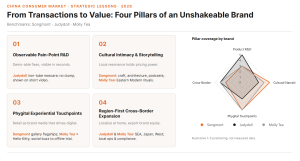
Analyzing the success of Songmont, Judydoll, and Molly Tea reveals a critical shift in China’s consumer market: sustainable growth in 2026 requires moving from transaction-based selling to value-driven brand building. To stand out in an increasingly crowded retail landscape, brands must execute on four core strategies to build lasting equity and capture consumer loyalty.
1. Ground Product R&D in Observable Consumer Pain Points
Generic products competing on low price are instantly vulnerable to cheaper alternatives. Modern breakout brands succeed by turning functional utility into a brand statement.
- The Lesson: Product innovation should be designed for instant demonstration and immediate pain-point resolution.
- Strategy in Action: Judydoll’s patented iron-tube mascara succeeded because it solved a specific, visible frustration—clumping and messy application—in a way that beauty creators could demonstrate within seconds on short-form video feeds. Brands in 2026 must engineer “hero products” whose functional benefits are immediately visible, converting everyday consumers into organic brand advocates.
2. Cultivate Cultural Intimacy and Emotional Storytelling
In a market saturated with loud promotional messaging, quiet cultural resonance creates pricing power and protects margins.
- The Lesson: Move away from discount-driven shopping festivals and focus on narrative-driven engagement that honors local culture and daily life.
- Strategy in Action: Songmont built an accessible luxury empire by avoiding aggressive Singles’ Day price cuts. Instead, it anchored its brand equity in regional craft heritage, architectural aesthetics, and intimate podcast campaigns centered on urban women’s emotional lives. For 2026, brands must anchor their identity in distinct aesthetic narratives or sensory experiences—much like Molly Tea’s “Eastern Modern” floral scent curation—turning routine purchases into emotional rituals.
3. Activate “Phygital” Experiential Touchpoints Across Channels
Brand trust in 2026 is reinforced when a consumer encounters consistent, high-quality experiences across both digital platforms and physical spaces.
- The Lesson: Physical retail is no longer just a distribution point; it is a brand-building media channel that drives digital engagement.
- Strategy in Action: Songmont designs its flagship stores as art galleries, while Molly Tea uses IP collaborations like Hello Kitty to drive massive foot traffic into its physical stores, turning online social buzz into offline trial experiences. Brands must build an integrated touchpoint strategy where short-form discovery on Xiaohongshu or Douyin leads seamlessly to immersive offline activations and high-retention online community touchpoints.
4. Drive Sustainable Expansion via Region-First Cross-Border Execution
Building a strong brand image requires balancing domestic market depth with strategic regional expansion across cross-border channels.
- The Lesson: Brands that master localized storytelling and compliance at home can seamlessly export their brand equity into overseas growth markets.
- Strategy in Action: Judydoll and Molly Tea successfully expanded into Southeast Asia, Japan, and Western markets by maintaining their core brand identity while adapting operational and compliance logistics locally. Global brands entering China—and Asian brands scaling into Southeast Asia—must partner with localized infrastructure specialists to ensure compliance, supply chain transparency, and message relevance.
What We Do at MyMyPanda
The strategies above are easy to describe and hard to execute. Brand-led growth across China and Southeast Asia requires operational infrastructure most brands don’t have in-house: platform compliance, localized content, supply chain visibility, and the discipline to protect brand equity while scaling.
That is the work MyMyPanda does. We are a regional cross-border e-commerce partner helping global brands enter China — and Asian brands scale into Southeast Asia — through brand-led growth rather than price-led volume.
In practice, that means:
- Market entry and compliance — platform onboarding, regulatory requirements, and category-specific rules across Tmall, Douyin, and regional marketplaces.
- Localized storytelling — omnichannel content and campaign execution built around your brand narrative, not a discount calendar.
- Cross-border infrastructure — supply chain coordination and logistics that keep quality and margins intact as you expand.
- Growth measurement — funnel and customer lifetime value tracking, so brand investment is tied to measurable outcomes.
Frequently Asked Questions (FAQs)
- Why is brand building more important than discounting in China’s modern retail economy?
Brand building is becoming more important because Chinese consumers are increasingly looking beyond low prices. They value product quality, emotional connections, cultural relevance, unique experiences, and brand trust. While discounts can generate short-term sales, strong brand equity helps businesses build customer loyalty, maintain healthy profit margins, and achieve sustainable growth.
- How are Chinese consumer preferences changing in 2026?
Chinese consumers, particularly younger urban buyers, are becoming more selective and brand-conscious. They increasingly prefer products that offer practical value, attractive design, cultural relevance, authentic storytelling, and memorable shopping experiences rather than simply choosing the cheapest available option.
- Which Chinese brands are successfully using brand storytelling to attract consumers?
Songmont, Judydoll, and Molly Tea are three examples highlighted in this blog. Songmont focuses on accessible luxury and cultural storytelling, Judydoll combines functional beauty products with social media engagement, and Molly Tea differentiates itself through floral-inspired tea experiences and Eastern Modern aesthetics.
- How does Songmont maintain its premium brand positioning without aggressive discounts?
Songmont builds its brand identity around craftsmanship, cultural heritage, architectural inspiration, and emotional storytelling. Instead of relying on promotional campaigns such as Singles’ Day and 618 discounts, the company focuses on product quality, accessible luxury positioning, and immersive retail experiences.
- What makes Judydoll successful in China’s competitive beauty market?
Judydoll’s success comes from combining product innovation, affordability, and social media engagement. Its products address specific consumer pain points, while collaborations and viral content on platforms such as Douyin and Xiaohongshu help increase brand visibility and consumer engagement.
- How does Molly Tea differentiate itself from other Chinese tea brands?
Molly Tea differentiates itself through its Eastern Modern brand identity, floral-inspired flavours, botanical ingredients, and distinctive brand character. By combining traditional tea culture with contemporary lifestyle experiences, it transforms everyday beverage purchases into memorable sensory experiences.
- What is the importance of social media platforms like Douyin and Xiaohongshu in brand building?
Douyin and Xiaohongshu play an important role in product discovery, consumer engagement, and brand awareness. Businesses can use short-form videos, influencer collaborations, user-generated content, and product demonstrations to communicate their brand stories and build stronger relationships with Chinese consumers.
- What is phygital retail, and why is it important for brands entering China?
Phygital retail combines physical and digital shopping experiences. It allows consumers to discover products online, interact with brands through social media, and experience products in physical stores. This integrated approach helps businesses improve customer engagement, strengthen brand trust, and create consistent shopping experiences across channels.
- How can international brands successfully enter China’s e-commerce market?
International brands should develop a localized market entry strategy that includes understanding Chinese consumer preferences, selecting suitable e-commerce platforms, meeting regulatory requirements, adapting marketing content, and establishing reliable supply chain and logistics operations. Building a recognizable brand identity is equally important for long-term success.
- How can brands expand from China into Southeast Asian markets?
Brands can expand into Southeast Asia by identifying regional consumer preferences, selecting suitable e-commerce marketplaces, localizing their content, maintaining supply chain transparency, and complying with local regulations. Working with an experienced cross-border e-commerce partner can simplify market entry and regional expansion.
- How can businesses build long-term customer loyalty without relying on discounts?
Businesses can build customer loyalty through consistent product quality, meaningful brand storytelling, personalized customer experiences, product innovation, reliable service, and authentic engagement. These strategies encourage repeat purchases and help create lasting emotional connections between consumers and brands.
- How can MyMyPanda help international brands enter China and expand into Southeast Asia?
MyMyPanda supports global brands entering China and Asian brands expanding into Southeast Asia through cross-border e-commerce solutions. Its services include marketplace onboarding, platform compliance, localized storytelling, campaign execution, supply chain coordination, logistics, and growth measurement to support sustainable brand-led expansion.
Conclusion
The common thread across Songmont, Judydoll, and Molly Tea is not a category, a price point, or a channel. It is a decision: each chose to build something consumers would seek out rather than something they would merely buy when it was cheap. That choice shows up in different forms — craftsmanship and cultural memory at Songmont, demonstrable product innovation at Judydoll, sensory ritual at Molly Tea — but the underlying logic is the same. Discounts buy a transaction. Brands buy a relationship, and relationships are what survive a deflationary market.
For brands entering China or Southeast Asia, the implication is blunt: operational logistics will get you into the market, but only brand equity will keep you there. The winners in 2026 will be the ones that treat brand building as infrastructure, not decoration — and that choose partners who understand the difference.
References
- Dudarenok, Ashley. Songmont: How A Chinese Handbag Brand Redefined Functional Luxury, 2026.
- Dudarenok, Ashley. Judydoll: How Product Innovation Is Taking a Chinese Makeup Brand Global, 2026.
- Daxue Consulting. Judydoll: How a C-beauty Brand Captured China’s Gen Z, 2025.
- CJDropshipping & Daxue Consulting. Why Judydoll Became a Viral Cosmetics Brand Among Consumers, 2026.
- Jing Daily. Are Chinese Handbag Brands Set to Dominate Accessible Luxury?, 2026.
- Molly Tea Official. About Us & Brand Heritage, 2026.
- Molly Tea New York. About – Molly Tea New York. Official Molly Tea US About Us page; a separate New York-specific About page was not verified.
- WalktheChat. From 0 to 10M RMB – Case Study of Songmont, 2021.