For international beauty brands entering China, choosing the right platform is about more than simply finding where consumers shop. China’s digital beauty market combines e-commerce, social content, product reviews, influencers, livestreaming and consumer recommendations.
A customer may discover a skincare product on Xiaohongshu, watch a demonstration on Douyin and then purchase it through an e-commerce platform such as Tmall Global.
This makes platform strategy an important part of China cross-border e-commerce (CBEC).
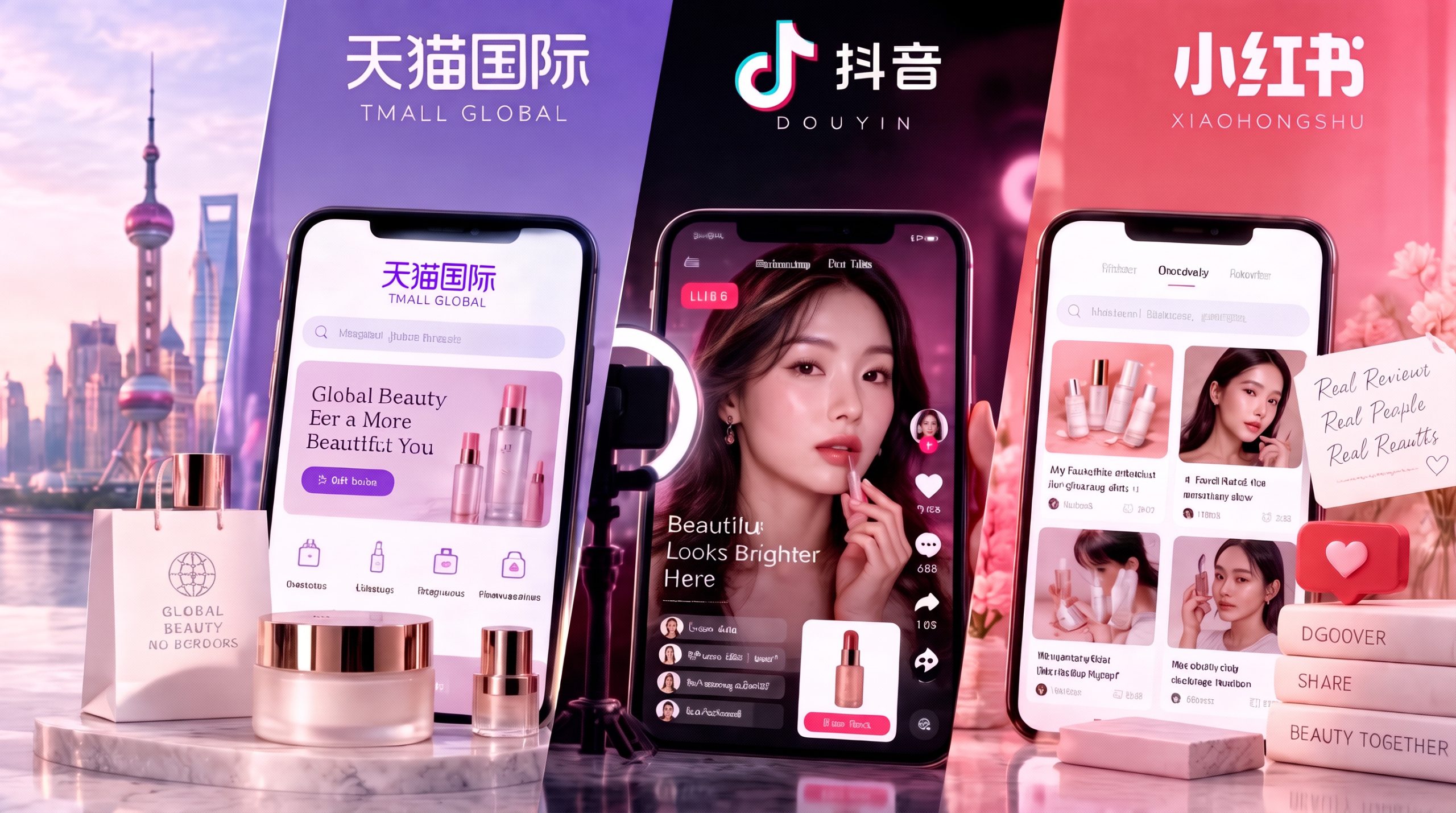
Three platforms are particularly relevant to international beauty brands: Tmall Global, Douyin and Xiaohongshu. Each plays a different role in the customer journey, and understanding those differences can help brands build a more effective China market strategy.
Tmall Global: Built Around Cross-Border Commerce
Tmall Global is Alibaba’s cross-border e-commerce platform for international brands and imported products. Its current merchant information positions it as a destination for Chinese consumers looking for overseas products and provides several models for international brands to enter the market. (Tmall International)
For beauty brands, Tmall Global can function as a dedicated e-commerce destination where consumers can:
- Explore products
- Compare options
- Read product information
- Check reviews
- Learn about the brand
- Make a purchase
This makes Tmall Global particularly relevant when a brand wants to establish a structured online sales presence in China.
Why Tmall Global Matters for Beauty Brands
Beauty consumers often want detailed information before purchasing. A brand storefront can communicate:
- Ingredients
- Product benefits
- Usage instructions
- Product collections
- Brand story
- Customer reviews
- Product comparisons
Tmall Global also offers different cross-border fulfilment models. For example, its Tmall Overseas Fulfillment programme is designed to help overseas brands test their sales potential in China using overseas inventory and direct fulfilment. (Tmall International)
For an international brand testing the Chinese market, this can provide flexibility before committing to a larger market-entry operation.
Douyin: Where Content Drives Commerce
Douyin approaches e-commerce differently.
Rather than relying primarily on consumers searching for products, Douyin can introduce products through short-form video, creators and livestreaming.
This is particularly relevant to beauty because products can be demonstrated visually.
A consumer may see:
- A skincare routine
- A makeup tutorial
- A product demonstration
- An ingredient explanation
- A creator recommendation
- A livestream
The consumer can then move from discovering the product to considering and purchasing it.
This creates a powerful journey:
Content → Discovery → Education → Interest → Purchase
Douyin’s international e-commerce ecosystem specifically provides opportunities for overseas brands to use Chinese creators and livestreaming to educate consumers and drive purchases. (Ocean Engine)
Why Douyin Works for Beauty
Beauty products are highly visual.
A video can demonstrate how a foundation looks on the skin, how a serum is applied or how a particular product fits into a skincare routine.
For international beauty brands, this creates opportunities for:
- Product tutorials
- Creator collaborations
- Livestream shopping
- Ingredient education
- Product demonstrations
- Beauty routines
- Product launches
However, brands should not simply translate their existing Instagram, TikTok or YouTube content into Chinese.
China requires a localised content strategy that understands the platform, its creators and its consumers.
Brands also need to consider the cost of content production, creator partnerships and traffic acquisition. McKinsey has noted that live-commerce growth in China can involve significant traffic-acquisition costs, making profitability an important consideration alongside sales volume. (McKinsey & Company)
Xiaohongshu: Discovery, Reviews and Consumer Research
Xiaohongshu has a different role in China’s digital ecosystem.
The platform is strongly associated with product discovery, recommendations, lifestyle content and consumer experiences.
For beauty brands, this can be particularly valuable because consumers often want to research a product before purchasing it.
They may ask:
- Has anyone used this product?
- What does it feel like?
- How should I use it?
- Is it suitable for my skin?
- What are the important ingredients?
- Is it worth the price?
- How does it compare with other products?
Xiaohongshu’s own commercial platform describes “product seeding” through authentic sharing as a way to build product awareness, reputation and consumer interest, while also providing solutions for conversion. (Xiaohongshu)
KOLs and KOCs
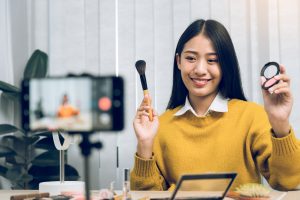
International beauty brands can work with both larger creators and smaller creators.
KOLs (Key Opinion Leaders) can provide reach and visibility.
KOCs (Key Opinion Consumers) and smaller creators can contribute personal experiences, reviews and niche audience engagement.
For beauty products, this can create a wider range of content around the brand.
For example, different creators might discuss the same product from different perspectives:
- Skincare routine
- Ingredient benefits
- Product texture
- Makeup application
- Personal experience
- Comparison with competing products
Xiaohongshu also provides tools for brands to work with creators and measure content and conversion performance. (Xiaohongshu)
Tmall Global vs. Douyin vs. Xiaohongshu
The simplest way to understand the difference is to consider the role each platform can play.
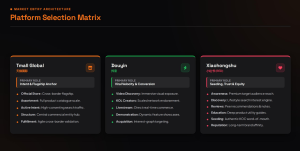
Tmall Global
Primarily focused on e-commerce, product discovery within a shopping environment and conversion.
Douyin
Focused heavily on short-form content, livestreaming, creator engagement and content-driven commerce.
Xiaohongshu
Focused strongly on discovery, recommendations, reviews, consumer research and brand perception.
These roles can overlap, but they are not identical.
Which Platform Is Right for a Beauty Brand?
There is no single platform that works for every international beauty brand.
The right choice depends on the product, target audience, brand awareness and commercial objective.
Tmall Global may be relevant when the priority is:
- Building an official cross-border store
- Selling a wider product range
- Capturing existing purchase intent
- Establishing a structured e-commerce presence
- Testing products through cross-border fulfilment models
Douyin may be relevant when the priority is:
- Video-led product discovery
- Creator marketing
- Livestream commerce
- Product demonstrations
- Content-driven customer acquisition
Xiaohongshu may be relevant when the priority is:
- Building awareness
- Product discovery
- Reviews and recommendations
- Consumer education
- KOL and KOC marketing
- Building product reputation
Why Brands Should Not Think About Only One Platform
For many international beauty brands, the answer may not be Tmall Global versus Douyin versus Xiaohongshu.
The platforms can work together.
For example:
Xiaohongshu → Discovery and research
A consumer discovers the brand through reviews, recommendations or educational content.
Douyin → Engagement and demonstration
The consumer sees the product being used and learns more through video or livestream content.
Tmall Global → Purchase
The consumer visits the brand’s e-commerce store and completes the purchase.
This creates a connected customer journey:
Discover → Research → Trust → Purchase → Repeat
Start With Consumer Behaviour
The platform strategy should ultimately begin with the consumer rather than the technology.
A premium skincare consumer may need detailed ingredient education and reviews.
A makeup consumer may respond strongly to visual demonstrations and creator content.
A well-known international brand may already have purchase intent and therefore need a strong e-commerce presence.
An emerging brand may first need to build awareness and credibility.
Understanding these differences allows brands to invest in the platforms that support their specific objectives.
The Role of Logistics and Compliance
Platform selection should also be considered alongside logistics and regulatory requirements.
International beauty brands need to understand how products will be stored, shipped, cleared through customs and delivered to Chinese consumers.
At the same time, cosmetics must meet the applicable Chinese regulatory requirements relating to areas such as ingredients, product classification, safety and claims.
This is why platform strategy should be part of a broader China market-entry plan rather than treated as an isolated marketing decision.
Building a China Beauty Platform Strategy
For international beauty brands, a practical approach is to:
- Define the target consumer
Understand who you want to reach and what influences their purchasing decisions. - Define the objective
Decide whether the immediate priority is awareness, discovery, engagement or sales. - Select the platform role
Give each platform a clear purpose rather than duplicating the same activity everywhere. - Localise the content
Develop Chinese-market content instead of simply translating international campaigns. - Connect content with commerce
Make it easy for consumers to move from discovering the product to purchasing it. - Measure the complete journey
Look beyond views and likes. Track searches, engagement, product visits, conversions, customer acquisition costs and repeat purchases.
Conclusion
Tmall Global, Douyin and Xiaohongshu each offer international beauty brands a different route into China’s digital consumer ecosystem.
Tmall Global provides a cross-border e-commerce environment focused on international products and commerce.
Douyin combines short-form content, creators and livestreaming with e-commerce.
Xiaohongshu plays an important role in discovery, recommendations, reviews and consumer research.
The key is not simply to choose the platform with the largest audience.
It is to understand where each platform fits into the customer’s journey.
For some brands, that may mean using Xiaohongshu to build awareness, Douyin to demonstrate products and Tmall Global to convert demand. For others, a different combination may make more sense.
For international beauty companies looking to enter China, a specialised cross-border e-commerce partner such as MyMyPanda can help connect platform strategy with localisation, market entry, content, logistics and commercial execution.
In China’s beauty market, successful digital commerce is increasingly about connecting discovery, trust and purchase—not treating each platform as a separate marketing channel.