A decade ago, many international beauty brands entering China believed product quality would determine success. Today, the numbers tell a different story.
Despite intense competition from South Korea, Japan, Australia, and Europe, American brands continue to hold a significant position in China’s cross-border e-commerce ecosystem. In 2025, China’s cross-border e-commerce imports and exports reached RMB 2.75 trillion (approximately USD 380 billion), representing a 69.7% increase since 2020 (General Administration of Customs of China, 2026). The United States remains the largest source country for cross-border imports into China, accounting for 67.2% of China’s cross-border transaction value (商指针, 2026).
But scale alone does not explain persistence. The real story is about something harder to replicate: trust.
Trust: The Currency That Actually Matters
Chinese consumers in 2026 are far more selective than they were a decade ago. Imported products no longer benefit from a broad perception of inherent superiority. Before making a purchase, consumers compare ingredients, read reviews, watch creator recommendations, and evaluate whether a product genuinely delivers on its promises.
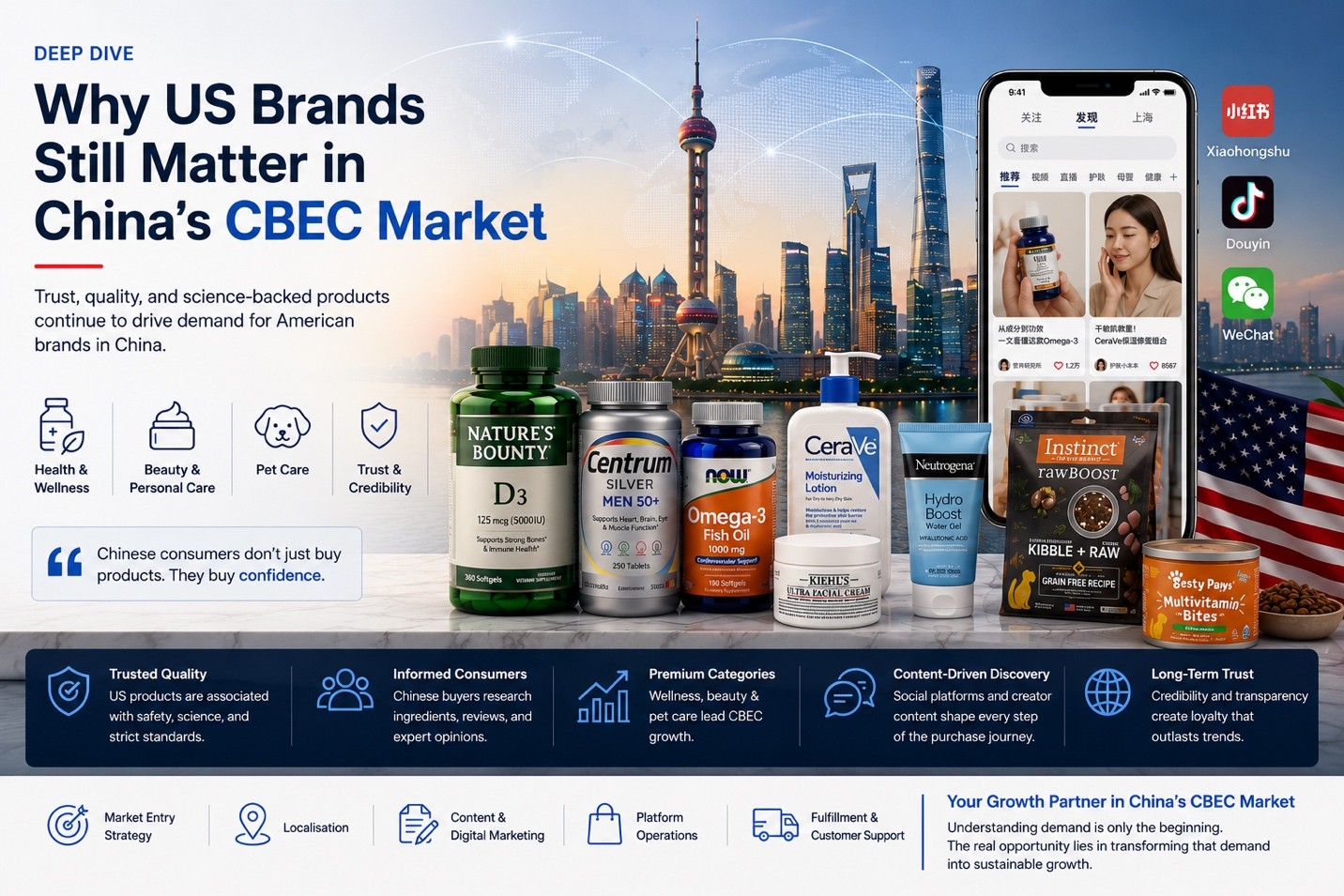
For years, products manufactured in the United States have been associated with scientific research, strict quality standards, and product safety. According to Euromonitor data cited by Shanghai Jungle (2026), on Tmall specifically, US brands led the imported supplement market at 34.2% market share, narrowly ahead of mainland Chinese brands at 31.1%. This reflects a deep-seated consumer perception that American supplements are backed by rigorous science and quality manufacturing standards.
In many categories, consumers are no longer buying products. They are buying confidence.
Health & Wellness: Where American Science Shines
The wellness boom in China shows no signs of slowing. The Chinese supplement market is expected to exceed RMB 430 billion (approximately USD 60 billion) by 2025, with annual growth rates consistently above 10% (2025年跨境进口保健品市场分析报告, 2025). Cross-border e-commerce has become the preferred entry route for international supplement brands.
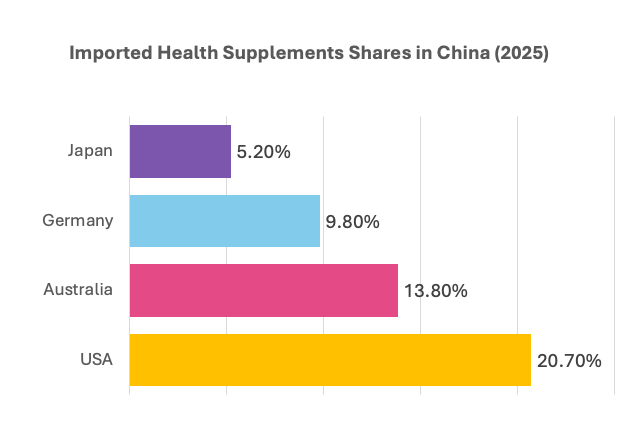 The United States is the largest source of imported health supplements into China, accounting for 20.7% of all imported supplement products, followed by Australia (13.8%), Germany (9.8%), and Japan (5.2%) (博观研究院, 2025).
Brands such as Nature’s Bounty, NOW Foods, and OLLY have built strong recognition among Chinese consumers seeking trusted nutritional supplements. During the 2024 Double 11 shopping festival on Douyin Global Shopping, OLLY achieved sales exceeding RMB 100 million (100 million CNY), alongside Swisse and New Zealand’s OXYENERGY (2025年跨境进口保健品市场分析报告, 2025).
In 2025, the China nutrition and health food import-export market grew significantly. The cross-border product market grew 11.4% year-over-year, outpacing domestic growth and signalling sustained strong demand for imported health products (中国医药保健品进出口商会, 2026).
Beauty: Efficacy Over Hype
South Korea may dominate conversations about beauty exports, but American beauty brands continue to carve out a meaningful and growing presence in China.
CeraVe, the dermatologist-developed skincare brand founded in the United States and now owned by L’Oréal, has been a standout performer. According to customs data compiled from Tmall and Tmall International, in the second quarter of 2025, CeraVe’s sales grew 23.61% year-over-year (小红书, 2025). The brand has cultivated a loyal following of “ingredient-focused” consumers drawn to its ceramide-based skin barrier technology and dermatological credibility.
Estée Lauder has also demonstrated remarkable resilience. In the first quarter of fiscal 2026 (ended September 30, 2025), the company reported net sales of USD 3.48 billion, a 4% year-over-year increase, driven by renewed momentum in its China business (China Daily, 2025). On the Chinese mainland, net sales rose 9% year-over-year to USD 532 million, up from USD 490 million a year earlier (China Daily, 2025). According to the company, China business “significantly outperformed prestige beauty” with retail sales increasing double digits ahead of the industry (China Daily, 2025).
During the second quarter of 2025, Estée Lauder’s sales on Tmall grew 36.39% year-over-year, with La Mer growing 82.98% and SK-II growing 42.89% (小红书, 2025). The company’s initiatives to enhance online consumer coverage across platforms such as Tmall, JD, and Douyin contributed to this first-quarter growth (China Daily, 2025).
L’Oréal also reported positive growth in China for the first time in two years, with its business on the Chinese mainland posting low single-digit growth in the third quarter of 2025, supported by a recovery in the Luxe division (China Daily, 2025). The growth benefited from an improved selective market and a robust innovation pipeline.
According to Euromonitor consultant Chloe Zhu, “There are indeed early signs of recovery in China’s beauty and personal care market… From the latest retail data, particularly social retail figures in September, we can see that the cosmetics sector is showing clear signs of a rebound” (China Daily, 2025).
The Surprising Rise of Premium Pet Care
 One of the most overlooked opportunities for American brands is pet care.
China’s pet economy has grown rapidly over the past decade as younger consumers increasingly treat pets as family members. According to ChemLinked (2025), the total import volume of pet food in the first half of 2025 reached 39,252.65 tonnes, representing a 15.52% year-on-year increase compared to the same period in 2024. The total import value grew by 7.75% year-over-year to RMB 1,706.66 million.
The United States remained the largest supplier of pet food to China, holding a dominant share of 70.76% of total import volume in the first half of 2025 (ChemLinked, 2025). Notably, the share of U.S. pet food in China’s total pet food import volume has expanded significantly over the years — from 18.07% in 2021 to 46.97% in 2022, further increasing annually to reach 70.42% in 2024 (ChemLinked, 2025). In the other packaged pet food category, the United States was the predominant supplier, contributing nearly 90% of this category’s import volume (ChemLinked, 2025).
Cross-border e-commerce has become an attractive entry point for imported pet food, offering advantages such as reduced regulatory hurdles, expedited customs clearance, and favorable tax policies (U.S. Department of Agriculture, 2025). According to the USDA (2025), one U.S. pet food brand was among the first set of pet brands to enter Tmall Global, leveraging the platform’s reach and adhering to its strict quality control measures to establish a foothold in the Chinese market.
For American brands, this represents a natural extension of their existing trust advantage. Pet owners increasingly apply the same standards to pet products that they apply to products for themselves — safety, ingredient quality, manufacturing standards, and brand reputation all influence purchasing decisions.
What the Numbers Tell Us About the Future
CBEC continues to grow as a channel for international brands. According to Shanghai Jungle (2026), there are now more than 165 CBEC comprehensive pilot zones across China, and CBEC trade increased by 15.5% in 2025 according to China’s Ministry of Commerce.
Tmall Global, JD Worldwide, and Douyin Global collectively account for approximately two-thirds of the CBEC market (Illuminera, 2026). As of February 2024, Tmall Global featured over 46,000 international brands from more than 90 countries, serving approximately 100 million Chinese consumers (U.S. Department of Commerce, 2025).
China remains the world’s largest e-commerce market, generating over $2.16 trillion in online retail sales in 2024 (U.S. Department of Agriculture, 2025). Food and beverage emerged as a top growth category at 15.8%, and cross-border e-commerce has become a viable entry channel for U.S. brands (U.S. Department of Agriculture, 2025).
However, the landscape is shifting. Domestic brands are gaining ground. A 2025 report from毕马威 (KPMG) cited by 第一财经 (2025) found that in the first three quarters of 2025, Chinese brand sales in the beauty sector grew 8.33%, with domestic brands capturing 56.87% market share — growing at 2.46 times the rate of foreign brands. Chinese consumers are becoming more selective, and regulatory scrutiny is increasing.
The Content Imperative
One of the biggest misconceptions foreign brands have about China is that consumers discover products the same way they do in Western markets. In reality, content has become one of the most important drivers of product discovery (U.S. Department of Agriculture, 2025).
A consumer may first encounter a supplement through a Xiaohongshu review, watch a creator discuss it on Douyin, compare recommendations in a WeChat community, and only then decide to make a purchase. The journey is rarely linear.
According to the U.S. Department of Agriculture (2025), this report examines platform dynamics among major players like Tmall, JD.com, Douyin, and Pinduoduo, and explores cross-border e-commerce as a viable entry channel for U.S. brands. By identifying growth opportunities and practical market-entry strategies, the report equips American exporters with actionable intelligence to enter China’s digital marketplace.
Brands that simply translate their existing marketing materials often struggle to gain traction. The companies that perform best are those that:
- Localize rather than translate — adapting visuals, messaging, and product positioning to Chinese consumer expectations
- Educate rather than promote — building trust through transparency and scientific credibility
- Test before committing — using small-scale market validation to gather real data before scaling investment
Looking Ahead
The United States remains an influential player in China’s CBEC landscape, particularly in categories where trust influences purchasing decisions. Health supplements (34.2% market share on Tmall, according to Euromonitor), beauty (with CeraVe growing 23.61% and Estée Lauder growing 36.39% in Q2 2025), personal care, and pet products (70.76% of import volume) continue to offer significant opportunities for brands willing to invest in localization, education, and long-term relationship building.
For international brands evaluating China as a growth market, the lesson is straightforward. Market access is easier than ever through CBEC channels. Building trust remains the real challenge. The brands that understand this distinction — and act on it — will be the ones best positioned for long-term success.
References
- 2025年跨境进口保健品市场分析报告. (2025, November 3). 小红书. https://www.xiaohongshu.com
- 博观研究院. (2025). 2025年中国跨境进口保健品市场分析报告. https://www.fxbaogao.com
- (2025, August 12). China’s pet food import data in H1 2025. https://food.chemlinked.com/market-insights/chinas-pet-food-import-data-in-h1-2025
- China Daily. (2025, November 6). Beauty MNCs see attractive sales in nation’s cosmetics market. https://global.chinadaily.com.cn/a/202511/06/WS690bfde0a310bfcd27fc5202.html
- 第一财经. (2025, December 25). 报告:中国品牌全球信任度大幅提升,发达市场成为突破关键. https://m.yicai.com
- General Administration of Customs of China. (2026, January 14). *2025年我国跨境电商进出口75万亿元,比2020年增长69.7%. https://finance.ifeng.com/c/8pu81JMB4je
- (2026, June 18). Winning in China with cross-border e-commerce: Strategies, models and case learnings. https://www.illuminera.com/1561.html
- 商指针. (2026, January 27). 2025全国外贸跨境出口电商数据分析报告. https://imgs-b2b.100ec.cn
- Shanghai Jungle. (2026, March 28). Guide to selling vitamins and supplements in China — market data, CBEC, and platform strategy. https://www.shanghaijungle.com
- 小红书. (2025, August 1). 根据我国海关总署最新数据,我国2025年上半年美容化妆品及洗护用品累计进口总数. https://www.xiaohongshu.com
- S. Department of Agriculture, Foreign Agricultural Service. (2025, August 11). China: China e-commerce report – Strategic insights for US food, agricultural and beverage exporters(Report No. CH2025-0146). https://apps.fas.usda.gov
- S. Department of Commerce. (2025, March 20). China cross-border ecommerce. https://www.trade.gov
- 中国医药保健品进出口商会. (2026, March 5). 中国营养保健食品进口步入质量提升关键期. 国际商报. https://www.comnews.cn