
Why unknown brands no longer need a local distributor to take the first step—and how CBEC changes the game.
For years, the standard playbook for foreign supplement brands entering China was simple: find a local distributor, hand over your products, and hope they build your brand.
That playbook is broken.
Today, the Chinese supplement market is the largest and fastest-growing in the world. But it has also become one of the most competitive, sophisticated, and digitally native markets anywhere. And in this new environment, distributors—especially for unknown brands—are stepping back.
This article explains why the traditional distributor model is fading, why CBEC (Cross-Border E-Commerce) is the superior entry route, and how building online awareness first actually makes distributors more willing to partner with you later.
📊 The Opportunity Is Real – But the Entry Model Matters
Let’s start with the numbers. China’s supplement market reached CN¥ 3,775 billion (≈US$520 billion) in 2025, and is projected to surpass CN¥ 4,000 billion in 2026. Growth is driven by an aging population, rising health awareness, and a massive shift to online purchasing.
Crucially, e-commerce now dominates. Online penetration for vitamins and dietary supplements reached 63% in 2025. Tmall holds 42% market share, followed by Douyin and JD.com at 16% each. In 2023 alone, online supplement sales on Taobao, Tmall, and JD.com hit CN¥ 115.45 billion, representing +24.6% year-on-year growth.
For any new brand, digital is not an optional channel—it is the primary channel.
❌ Why Distributors Are Walking Away from Unknown Brands
If you are a supplement brand with zero brand awareness in China, ask yourself: Why would a distributor take the risk of carrying your products and bearing the full burden of selling them?
The honest answer is: they won’t.
Distributors are commercial operators, not brand builders. They typically sign ten brands at once and only put serious effort behind the one or two that already show organic traction. The rest are left to fail.
Here’s why distributors are increasingly reluctant to work with unknown brands:
| Risk Factor | What It Means for Your Brand |
| No local awareness | Distributors must spend their own money to educate consumers—with no guarantee of return. |
| Short-term thinking | Distributors often undercut pricing or sell through unofficial channels to make quick profit, damaging your brand long-term. |
| Poor brand representation | Your products end up on generic, multi-brand store pages with bad translations and no compelling story. |
| High upfront costs | Import duties, warehousing, and marketing require significant capital—risk distributors no longer want to take. |
The bottom line: For a new, unknown brand, a distributor’s willingness to take on risk is becoming vanishingly small. There are already hundreds of well-performing supplement brands in China. Why would a distributor gamble on you?
🏆 The Competition Is Fierce – And Getting Fiercer
Even if you find a distributor, you will enter a market dominated by established players.
Local giant By-Health (汤臣倍健) and Australian brand Swisse (which holds 4.5% market share and generated CN¥ 6.38 billion in 2025 alone) have deep consumer trust and massive marketing budgets.
Winning in this environment requires more than just “being available.” It requires:
- Data-driven innovation (e.g., brain health supplements grew +50.6%, digestive enzymes +366.4%)
- Multi-platform presence (Tmall, JD, Douyin, Xiaohongshu – all at once)
- Localized marketing (KOLs, celebrity endorsements, educational content)
Most distributors cannot execute this playbook. And without it, an unknown brand has almost no chance of breaking through.
✅ The Solution: A Direct-to-Consumer (DTC) Approach via CBEC
The alternative is not just better—it is the only viable path for new supplement brands. Cross-Border E-Commerce (CBEC) allows you to sell directly to Chinese consumers through platforms like Tmall Global and JD Worldwide, bypassing distributors entirely.
Here’s how CBEC compares to traditional distribution:
| Feature | CBEC (Direct-to-Consumer) | Traditional Distribution |
| Market entry speed | Fast (2–4 months) | Slow (18 months – 5 years) |
| China entity required | No | Yes (WFOE or joint venture) |
| Product registration | No “Blue Hat” certification needed | Mandatory Blue Hat (costly & slow) |
| Tax rate | Low (~9.1% on retail price) | High (~30% on import price) |
| Brand & pricing control | Complete control | Low to none |
| Customer data access | Direct access to your consumers | Owned by distributor |
The advantages are clear:
- Lower risk – Test the market with minimal upfront investment.
- Faster learning – Real-time consumer data tells you what works.
- Full control – Your brand story, your pricing, your customer relationships.
🔁 The Missing Piece: CBEC Creates Awareness That Makes Distributors Willing to Act
Here is a point most brand owners miss: once you prove your brand online—even modestly—distributors become interested again.
The problem today is not that distributors refuse to work with brands. It’s that they refuse to work with invisible brands.
CBEC changes that. When you enter via Tmall Global or JD Worldwide, you generate tangible, public proof points that distributors can see and evaluate:
| Proof Point | What Distributors See | Why It Lowers Their Risk |
| Store sales volume | Monthly GMV, best-selling SKUs | Demand is real, not hypothetical |
| Consumer reviews & ratings | Authentic buyer feedback | Product quality is validated |
| Social media mentions | Xiaohongshu notes, Douyin clips | Organic interest exists |
| KOL partnerships | Trackable traffic and conversion | Marketing playbook is proven |
| Repeat purchase rate | Customer loyalty data | Long-term potential |
Once these signals exist, a distributor no longer has to act as a blind pioneer. Instead, they become a scaling partner—someone who takes a brand that has already found product-market fit and accelerates it into offline retail, cross-border B2B, or broader domestic channels.
This is the new logic for supplement brands entering China:
CBEC first → Build awareness → Prove demand → Then attract distributors as partners, not gatekeepers.
You don’t need a distributor to believe in you. You need to make believers out of Chinese consumers first. Then distributors will come to you.
🧭 What This Means for Supplement Brand Owners
| Old Thinking | New Reality |
| “Find a distributor to handle everything.” | “Use CBEC to prove your brand first.” |
| “Distributors take all the risk.” | “You must de-risk the market yourself.” |
| “Go offline as fast as possible.” | “Win online first—offline follows.” |
| “Distributors build brand awareness.” | “You build awareness. Distributors scale it.” |
The Chinese supplement market is too large, too fast-moving, and too competitive to leave your brand’s fate in the hands of a third-party distributor who has no incentive to build you from zero.
CBEC gives you a direct line to consumers, a testing ground for product-market fit, and—perhaps most importantly—a way to generate the online proof that later makes distributors compete to work with you.
🚀 Your Next Step
As a China CBEC service provider, MyMyPanda helps supplement brands like yours:
- Set up and operate RedNote, Douyin, Tmall Global / JD Worldwide stores
- Navigate cross-border logistics and compliance, bonded warehouse & China payment
- Execute localized marketing (Content marketing on RedNote, KOLs livestream in Douyin)
- Ecommerce store customer service, order fulfilment and last mile logistics
- Track consumer data to optimize your product and pricing
The days of passive distribution are over. The era of direct, data-driven brand building has begun.
Are you ready to take control of your brand’s future in China?
👉 Contact us to discuss your CBEC entry strategy.
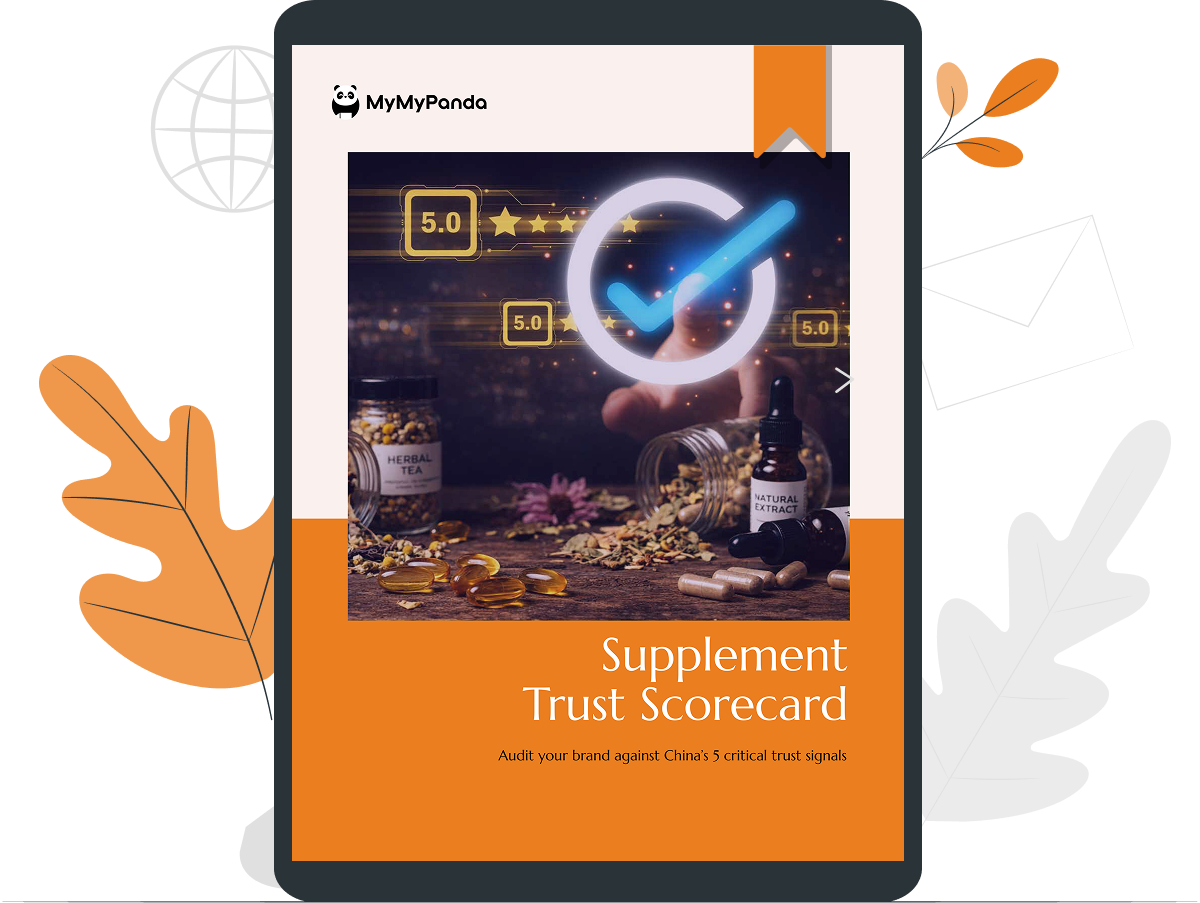
China CBEC Reality Check
Is Your Supplement China-Ready?
Take the Supplement Trust Scorecard. Uncover weak spots in labels, claims, manufacturing proof, and social validation.