The Country That Built a Playbook Everyone Else Is Still Trying to Copy
A decade ago, many international beauty brands entering China believed product quality would determine success.
Today, the numbers tell a different story.
Despite intense competition from Europe, the United States, Japan, Australia, and emerging Southeast Asian brands, South Korea continues to punch above its weight in China’s cross-border e-commerce ecosystem.
Walk through Xiaohongshu’s beauty rankings, browse Douyin livestreams featuring imported skincare, review CBEC category leaders across cosmetics, supplements, and personal care. A pattern quickly emerges – South Korean brands consistently occupy a disproportionate share of consumer attention.
The obvious explanation is K-Beauty. The real explanation is much bigger.
South Korea did not simply export products. It exported culture, trust, aspiration, and a content ecosystem that perfectly matched how Chinese consumers discover brands in the digital era.
The question for international brands is no longer:
“Why are Korean brands successful?”
The more important question is:
“What can other countries learn from South Korea’s playbook before the opportunity becomes even more competitive?”
South Korea’s Advantage Started Long Before CBEC
One of the biggest mistakes brands make when analysing China’s import market is assuming success begins at the point of sale. In reality, consumer preference is often formed years earlier.
By the time many Korean brands officially entered China, consumers were already familiar with:
- Korean dramas
- K-Pop artists
- Korean celebrities
- Korean beauty standards
- Korean lifestyle trends
This created something every marketer wants but few achieve:
Pre-built consumer trust
While other international brands were spending heavily on awareness campaigns, Korean brands entered the market with years of cultural exposure already working in their favour.
The data supports this. According to Korea Customs Service data, exports to China reached $9.25 million in January–February 2025 — 3.5 times the amount from the same period the previous year. For the six months ending February 2025, cumulative exports exceeded $31.52 million, more than double the previous year’s total. This indicates that China’s demand for Korean cultural content remained strong even through the informal “Korean Wave restrictions” period.
Korean entertainment companies have also deepened their China connections. In May 2025, Tencent Music Entertainment invested 1.29 billion yuan to become the second-largest shareholder of Korea’s SM Entertainment, the agency behind global K-Pop acts like EXO and aespa.

The Korean wave also profoundly influenced Chinese consumer culture through highly interactive fan engagement models, as seen in programs like “PRODUCE 101,” which leveraged social media and fan voting mechanisms to shape a new generation of Chinese entertainment consumption habits.

The most successful Korean brands understand that products rarely succeed in isolation. Instead, products become part of a broader ecosystem of culture, aspiration, and community.
Why K-Beauty Changed the Rules of CBEC
Before Korean brands reshaped the market, beauty marketing largely focused on brand prestige. Korean companies introduced a different approach. Rather than selling status, they sold routines. Instead of promoting a single product, they promoted:
- Skincare education
- Layering techniques
- Ingredient awareness
- Preventative care
Consumers were not simply buying moisturizers. They were buying into a philosophy.
This distinction matters because modern Chinese consumers increasingly purchase outcomes rather than products.
The scale of Korean success in China’s CBEC market is remarkable. According to the Korean Ministry of Food and Drug Safety, in the first half of 2025, South Korea surpassed the United States for the first time to become the world’s second-largest cosmetics exporter, trailing only France. During this period, Korean beauty exports grew 14.8% year-over-year to $5.5 billion, marking the highest first-half export figure in five years, with China absorbing a substantial share.
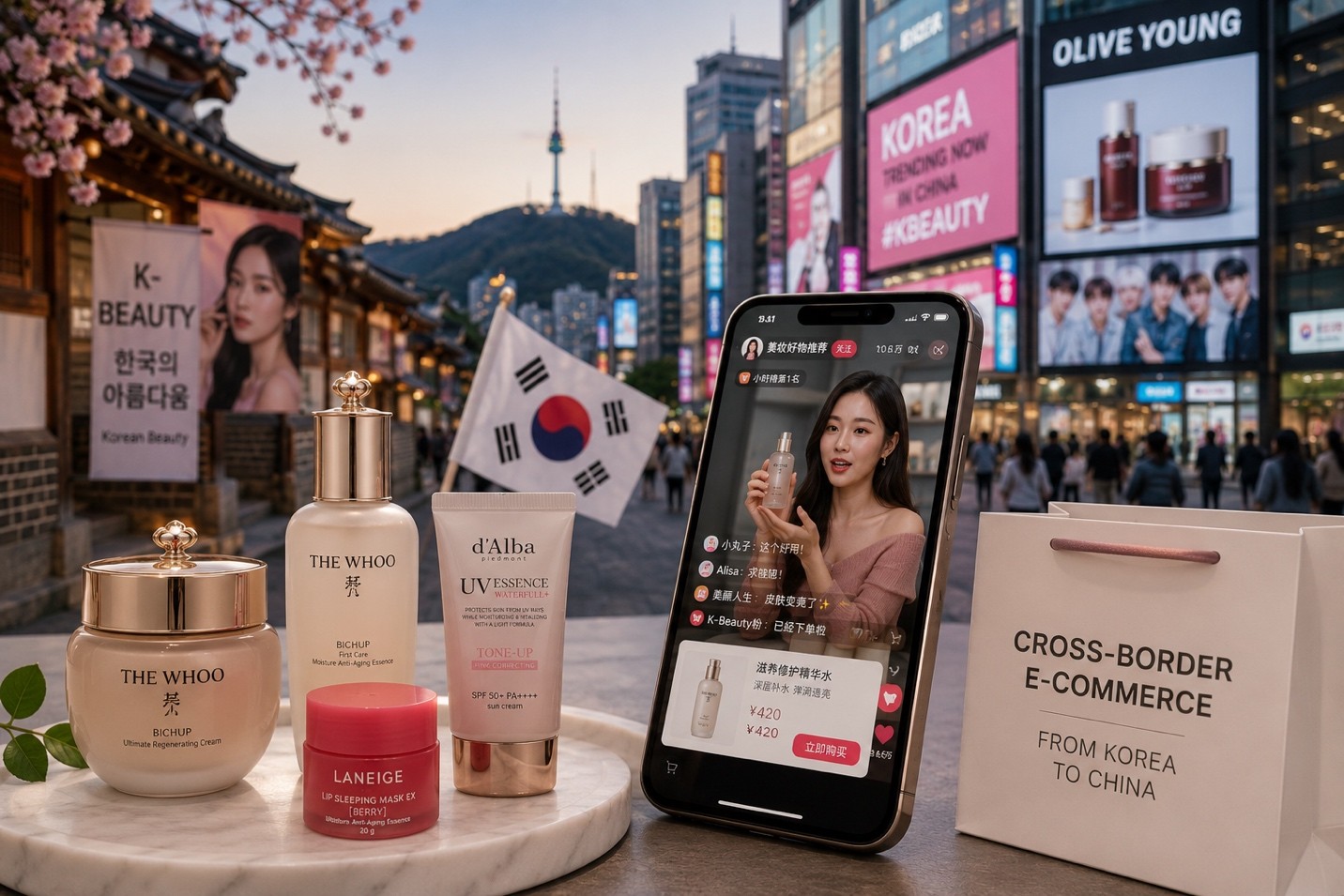
In the Douyin Global Shopping Double 11 period of 2025, Korean beauty brands saw year-on-year sales increase over 170%, with daily average sales exceeding 100 million RMB. Sales of Korean cosmetics through South Korea’s overseas direct purchase channels reached 228.5 billion KRW, underscoring the sustained strength of cross-border demand. Products like THE WHOO (Whoo Hoo) ranked at the top of beauty bestseller charts.
Case Study: THE WHOO — From Counter to Category Captain
Few brands illustrate the power of Korea’s CBEC playbook better than THE WHOO.
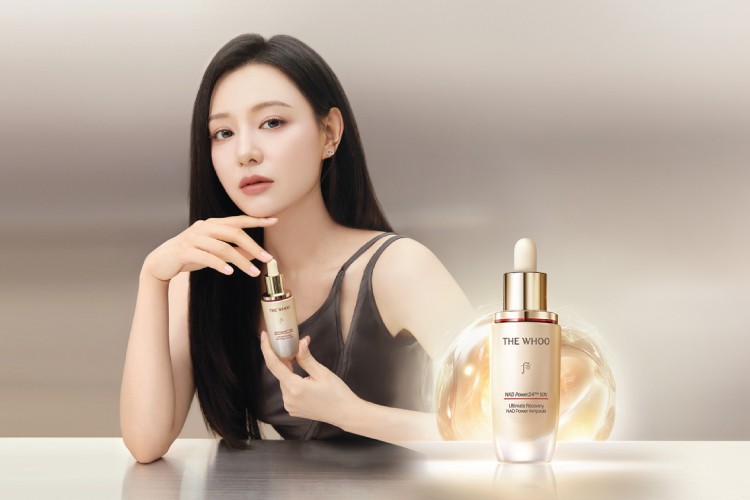
According to data from Douyin Global Shopping, THE WHOO achieved monthly sales exceeding 100 million RMB on Douyin, with 85.77% of sales coming directly from livestreams. This demonstrates the platform’s effectiveness in turning content-driven engagement into substantial revenue.
Throughout 2025, the brand performed strongly across major shopping festivals. During Double 11, THE WHOO’s product lines consistently appeared among the top beauty SKUs on Douyin Global Shopping, alongside other Korean cosmetics and health brands.
THE WHOO’s journey through China’s beauty market has spanned multiple retail phases — from offline specialty stores and traditional e-commerce to cross-border channels and livestream commerce — adapting its strategy at each stage to maintain relevance amid shifting consumer preferences.
However, THE WHOO’s success is not without its challenges. The brand’s parent company, LG H&H, reported that THE WHOO accounted for 55% of its beauty division revenue in 2023, and the brand has consistently ranked in Tmall Global’s top 10 beauty brands. Yet the broader Korean beauty landscape in China has seen headwinds: major brands like Innisfree, Laneige, and Etude House have undergone significant market adjustments and store closures as Chinese domestic beauty brands (C-Beauty) have captured market share. This underscores a critical point — the Korean advantage is not static, and sustained success requires continuous evolution.
Case Study: Colorgram — The K-Pop Connection
The intersection of Korean entertainment and beauty is perhaps nowhere more visible than in the success of Colorgram.
Launched by Korea’s Olive Young, Colorgram is a trendy color cosmetics brand that entered China through Tmall Global. It quickly gained traction using affordable pricing and K-Pop influencer marketing, resonating strongly with young Chinese female consumers — the “girly economy.” Products like the “Tanghulu Lip Gloss” and “Little Rice Cake Lip Lacquer” became viral hits.
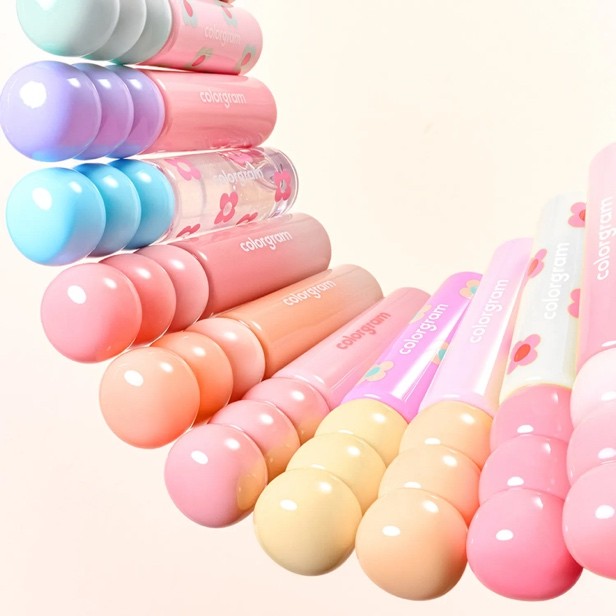
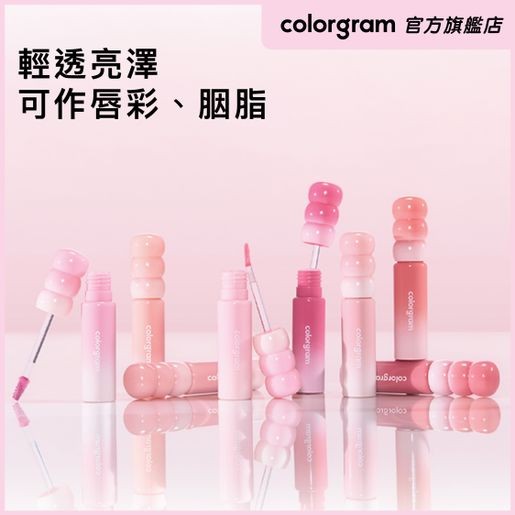
The brand’s manager noted that “the return of the Korean Wave has driven a surge in searches for K-beauty. Platform new product seeding provides strong endorsement, promoting transaction conversion.” By leveraging Tmall’s ecosystem, Colorgram successfully transitioned short-term explosive growth into stable, sustained performance.
In June 2025, Weverse Shop — the official merchandise platform for K-Pop artists — opened a flagship store on Tmall International, capitalizing on the same fan-driven engagement model. This highlights how Korea’s cultural export strategy extends well beyond beauty and into virtually every consumer-facing category.
The Second Wave: Health, Wellness and Functional Consumption
Many observers still associate South Korea primarily with cosmetics. That perspective is outdated. The fastest-growing opportunities increasingly sit at the intersection of:
- Beauty
- Nutrition
- Wellness
- Preventative health
Chinese consumers are becoming more focused on:
- Healthy aging
- Gut health
- Immunity
- Functional ingredients
- Daily wellness routines
This has created new opportunities for Korean supplement and wellness brands.
Korean companies have responded with strategic partnerships. In August 2025, Cosmax Bio, a leading Korean original design manufacturer (ODM) of health functional supplements, signed a memorandum of understanding (MOU) with Tmall Global to strengthen cooperation in the health supplement sector. The partnership aims to stably produce health supplements tailored to Chinese consumer preferences and develop diverse new products, calling it a key opportunity to expand export channels.
Tmall Global, with over 880 million monthly active users, represents a massive distribution channel for Korean health brands. This move complements the earlier “K-Beauty China Renaissance Plan” announced in June 2025, when Korean ODM giant Kolmar Korea partnered with Tmall Global to create a “green channel” for Korean beauty SMEs to access the platform’s 880 million monthly active users. The parallel structures for beauty and health suggest that Korea views China’s wellness market as the next frontier for cross-border growth.
More than 50 pet supplement brands entered CBEC in 2025 — and the trend shows no signs of stopping. Over 1,400 SKUs from the EU and beyond now flood Tmall Global and JD Worldwide.
What Most Countries Get Wrong
After studying successful Korean exporters, three common differences emerge.
Mistake #1: Selling Products Instead of Lifestyles
Korean brands sell aspirations. Many competitors sell specifications.
The evidence: Korean brands on Douyin Global Shopping grew 170% year-over-year in 2025, with daily sales exceeding 100 million RMB. This growth came not from better products alone but from integrating products into Korean cultural narratives that Chinese consumers already found compelling.
Mistake #2: Treating Content as Marketing
Korean brands treat content as part of the product experience.
Consider that on Douyin Global Shopping, over 70% of consumers complete purchases through short videos or livestreams — with creator-driven content contributing over 65% of total GMV. Korean brands have recognized that content is not merely promotion; it is the product’s primary interface with consumers.
Mistake #3: Chasing Reach Instead of Trust
Trust compounds. Reach expires.
The strongest Korean brands understand this better than most. According to the 2025 Q2 New Super Star Brand List published by Tmall Global, Korean brands ranked prominently among emerging cross-border brands, with Colorgram and Weverse Shop securing top spots. These brands understood that trust and community — not just awareness — drive sustainable growth.
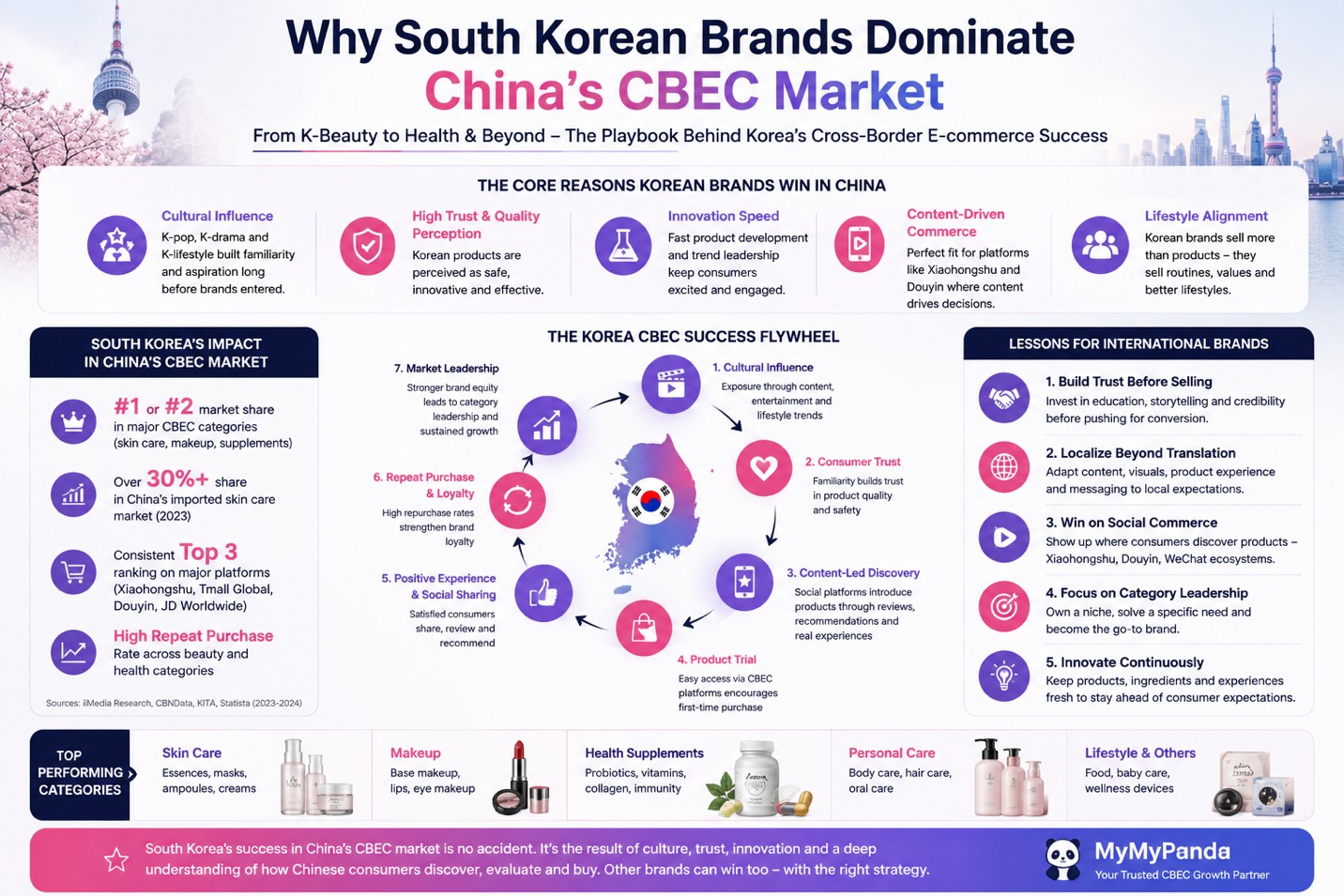
The South Korea CBEC Success Formula
The Regulatory and IP Dimension
Behind the success of Korean brands in China lies a sophisticated approach to regulatory compliance, intellectual property protection, and strategic market entry. China’s regulatory landscape for imported goods has become increasingly rigorous, and Korean brands have adapted effectively — often more successfully than their Western counterparts.
K-Beauty’s “Green Channel” to China
The June 2025 partnership between Korean ODM leader Kolmar Korea and Tmall Global — the “K-Beauty China Renaissance Plan” — created a systematic process for Korean SMEs to enter the Chinese market. By leveraging Tmall’s 880 million monthly active users, the initiative offers Korean brands a relatively streamlined regulatory path that many other international brands lack.
IP Protection: The Korean Bulletproof Strategy
Counterfeiting remains a significant concern for premium beauty brands. Korean brands have been particularly aggressive in trademark registration, supply chain monitoring, and platform enforcement. A notable example: Korean “white label” brands — products manufactured in Korean factories under Chinese-owned brand names — have become sophisticated. The most common operational method involves Chinese entrepreneurs establishing brand management companies in Korea, contracting with Korean ODM factories for production, and then introducing the products into China under Korean brand identities. This model ensures that the “Korea-made” label remains authentic, reducing counterfeiting risks and maintaining consumer trust.
GACC and MARA Registration for Korean Health Products
For cross-border health supplements and functional foods, Korean brands have navigated China’s customs and quarantine requirements more systematically than many competitors. The Cosmax Bio partnership with Tmall Global in August 2025 explicitly includes the objective of “producing health supplements tailored to Chinese consumer preferences” — implying deep alignment with China’s regulatory frameworks for imported nutrition products.
According to GACC Order 280, which took effect June 1, 2026, new registration pathways and stricter food safety oversight apply to all imported food products, including pet food and supplements. Korean exporters have been proactive in maintaining GACC facility registrations — as of 2025, the list of GACC-approved countries for pet food export to China includes South Korea alongside major markets like the United States, Canada, the EU, Australia, and New Zealand. This compliance-first approach has allowed Korean health brands to maintain stable cross-border supply chains while competitors faced regulatory bottlenecks.
What This Means for International Brands
South Korea’s dominance is not really a story about skincare.
It is a story about understanding modern consumer behavior.
The brands winning in China’s CBEC market today are not necessarily those with the biggest budgets. They are the brands that build trust before selling, educate before promoting, and create communities rather than transactions.
For international brands evaluating China in 2026 and beyond, South Korea’s experience offers one of the clearest blueprints for sustainable growth.
Final Thought
The Korean playbook is not magic. It is methodical.
It starts with cultural resonance, deepens with trusted creator partnerships, and converts with seamless social commerce. The brands that master this sequence — regardless of their country of origin — will be the ones that thrive in China’s increasingly sophisticated digital economy.
The question is not whether you can compete with Korean brands.
The question is whether you can learn from them.