China offers significant opportunities for international beauty brands, but entering the market requires more than setting up an online store and starting advertising.
Cosmetics sold in China are subject to specific regulatory requirements covering product classification, ingredients, safety, registration or filing, labelling and efficacy claims.
For international brands planning to enter China through cross-border e-commerce (CBEC), understanding these requirements early can help avoid unnecessary delays and compliance issues.
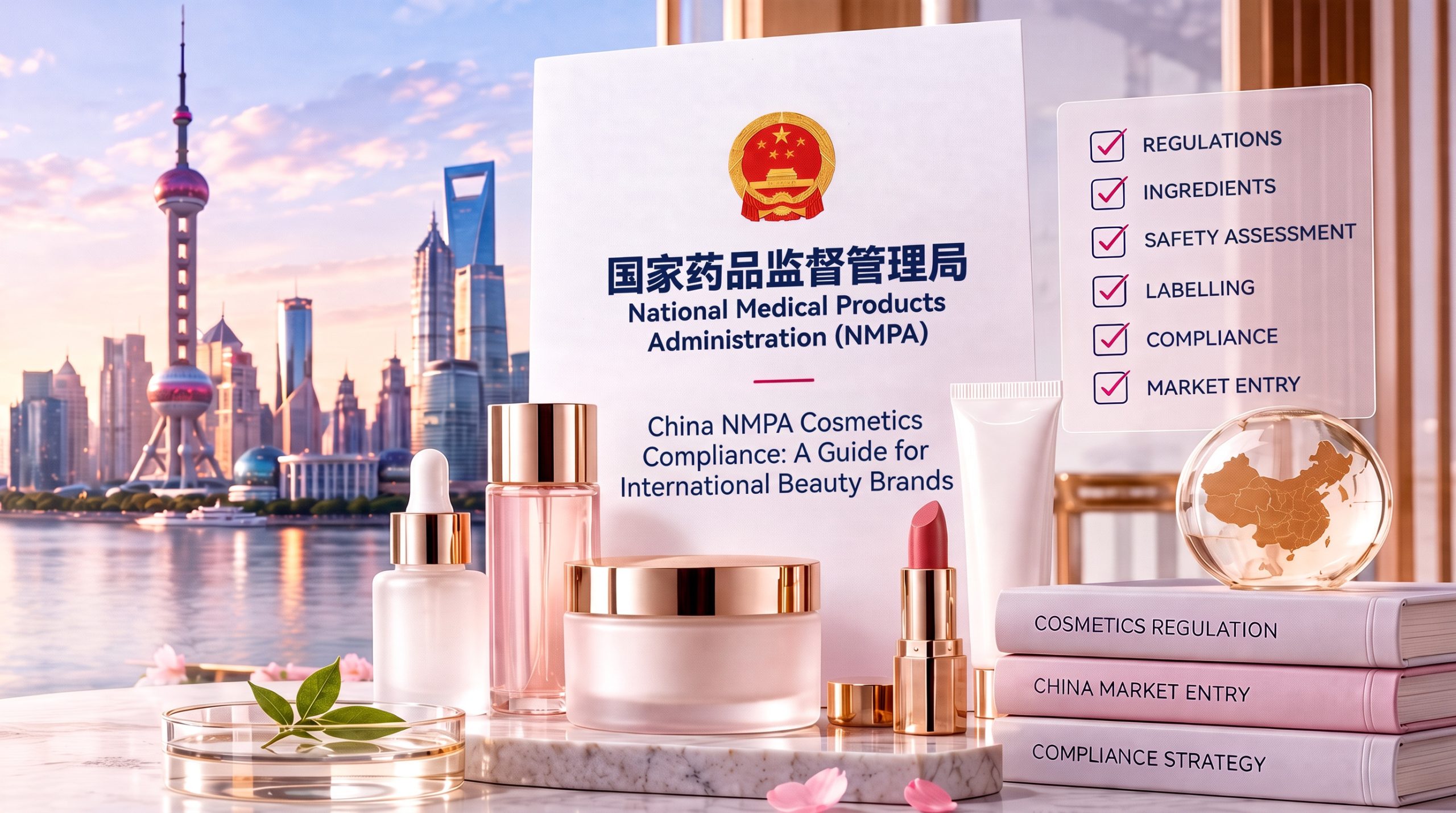
The National Medical Products Administration (NMPA) plays a central role in China’s cosmetics regulatory framework. Brands should understand the applicable requirements before finalising their China launch strategy.
What Is the NMPA?
The National Medical Products Administration (NMPA) is China’s national authority responsible for supervising and administering cosmetics, among other regulated products.
China’s cosmetics framework places responsibilities on cosmetic registrants and filing persons for product quality and safety, as well as the accuracy and scientific basis of submitted information.
For international beauty brands, this means compliance should be considered from the beginning of the China market-entry process rather than treated as an administrative step just before launch.
General Cosmetics vs. Special Cosmetics
One of the first things an international beauty brand needs to determine is how its product is classified in China.
China generally divides cosmetics into:
General cosmetics
These products are subject to a filing process.
Special cosmetics
These products require registration and include specific categories such as certain hair dyeing, perming, sun-protection, anti-hair-loss and freckle-removing or whitening products.
The classification can affect the regulatory pathway, documentation and launch preparation required.
A product classified as a general cosmetic in another country should not automatically be assumed to have the same classification in China.
The product should be assessed according to China’s applicable regulatory framework.
Registration vs. Filing
Registration and filing are two different regulatory pathways.
For general cosmetics, the required filing needs to be completed before the product is marketed or imported under the applicable rules.
Special cosmetics require registration before production or import.
The requirements can involve information such as:
- Product formula
- Product standards
- Safety information
- Testing information
- Product labels
- Manufacturing information
- Supporting documentation
Understanding the correct pathway early can help international brands plan realistic launch timelines.
The Importance of the China Domestic Responsible Person
International companies also need to understand the role of the domestic responsible person in China.
Overseas registrants and filing persons are required to designate a China-based enterprise legal person as their domestic responsible person under the applicable cosmetics regulations.
This role can involve supporting activities such as:
- Registration or filing
- Communication with authorities
- Adverse-reaction monitoring
- Product safety responsibilities
- Regulatory documentation
For international brands, choosing an appropriate domestic responsible person should therefore be part of the China market-entry structure.
It should not be treated as a simple administrative contact.
Ingredient Compliance
An ingredient permitted for use in one country is not automatically sufficient for the Chinese market.
International beauty brands should review their complete formulation before launching in China.
This can include checking:
- Ingredient names
- Ingredient status in China
- Concentrations
- Intended functions
- Applicable restrictions
- Safety information
- Whether an ingredient is considered a new cosmetic ingredient
China maintains an Inventory of Existing Cosmetic Ingredients (IECIC), which is an important reference point when assessing cosmetic formulations.
The NMPA has also updated its approach to the ingredient inventory, demonstrating that China’s regulatory environment continues to develop.
Brands should therefore verify the current regulatory status of their ingredients before launch.
New Cosmetic Ingredients

China defines a new cosmetic ingredient as a natural or artificial ingredient used in cosmetics for the first time in China.
Depending on the ingredient and its intended use, registration or filing requirements may apply.
This can be particularly important for innovative beauty brands using:
- New active ingredients
- Novel botanical extracts
- Advanced formulations
- New cosmetic compounds
- Emerging biotechnology ingredients
International brands should assess these ingredients early in the product-development and market-entry process.
Discovering a regulatory issue after the product has already been prepared for launch can result in unnecessary delays.
Safety Assessment
Safety assessment is an important part of China’s cosmetics regulatory system.
International brands need to ensure that the required safety information and assessment documentation are prepared according to the applicable Chinese requirements.
The NMPA has introduced measures to optimise the management of cosmetics safety-assessment information while maintaining the responsibility of registrants and filing persons for product safety.
Certain products, including children’s cosmetics and relevant special cosmetics such as freckle-removing and whitening products, can require more extensive safety-assessment documentation.
Brands should therefore determine the appropriate level of safety assessment for each product rather than assuming that a safety file prepared for another market will automatically be sufficient.
Product Labels and Chinese Packaging
Labelling is another important area for international beauty brands.
Cosmetic products sold in China need to comply with applicable Chinese labelling requirements.
Depending on the product, labels may need to communicate information such as:
- Chinese product name
- Ingredient information
- Net content
- Shelf life
- Manufacturer information
- Registrant or filing information
- Usage instructions
- Safety warnings
- Relevant registration or filing information
The information presented on the packaging should also be consistent with the relevant registration or filing documentation.
Simply translating an existing international label into Chinese does not necessarily make it compliant.
Brands should review their packaging specifically for the Chinese market before production.
Efficacy Claims Need Careful Attention
Beauty brands naturally want to communicate product benefits.
However, claims used in China need to be supported appropriately and comply with the applicable requirements.
Claims relating to areas such as:
- Whitening
- Anti-ageing
- Sun protection
- Hair loss
- Skin repair
- Sensitive skin
- Other specific cosmetic effects
may require supporting evidence and careful regulatory review depending on the product and claim.
China has established standards for evaluating cosmetic efficacy claims, and brands should ensure that their claims are supported by appropriate evidence.
The safest approach is to review claims before finalising marketing content.
This should include not only packaging, but also:
- E-commerce product pages
- Advertisements
- Social media posts
- Influencer content
- Promotional videos
Compliance Does Not End After Launch
One of the most important things international brands should understand is that compliance is not simply a one-time registration or filing exercise.
After launch, brands may still have responsibilities relating to:
- Product safety
- Adverse-reaction monitoring
- Regulatory documentation
- Product changes
- Quality management
- Risk control
- Recalls where necessary
This means international brands should have an ongoing compliance process rather than treating regulatory approval as the final step.
Common NMPA Compliance Mistakes
1. Assuming overseas approval is enough
Approval in the EU, UK, US or another market does not automatically mean that the product meets China’s requirements.
2. Checking ingredients too late
Ingredient compliance should be reviewed before the China launch strategy is finalised.
3. Confusing general and special cosmetics
The two categories have different regulatory pathways and requirements.
4. Reusing international claims
Marketing claims should be reviewed specifically for the Chinese market.
5. Treating translation as compliance
A translated label is not necessarily a compliant Chinese label.
6. Ignoring the domestic responsible person
International companies need to understand the role and responsibilities of the China-based domestic responsible person.
7. Forgetting post-market responsibilities
Regulatory responsibilities can continue after the product reaches consumers.
Before launching a beauty product in China, international brands should consider the following:
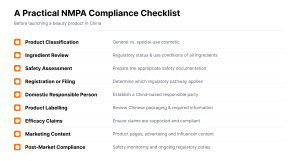
Product Classification
Determine whether the product is a general or special cosmetic.
Ingredient Review
Check the regulatory status and use conditions of all ingredients.
Safety Assessment
Prepare the appropriate safety documentation.
Registration or Filing
Determine which regulatory pathway applies.
Domestic Responsible Person
Establish the appropriate China-based responsible-party structure.
Product Labelling
Review Chinese packaging and required information.
Efficacy Claims
Ensure claims are supported and comply with applicable requirements.
Marketing Content
Review product pages, advertising and influencer content.
Post-Market Compliance
Establish processes for safety monitoring and ongoing regulatory responsibilities.
How Compliance Fits Into China CBEC
NMPA compliance should not be treated as something separate from a China cross-border e-commerce strategy.
The different parts of market entry are connected:
Product → Compliance → Registration/Filing → Platform → Logistics → Marketing → Consumer
For example, product classification can affect the regulatory pathway. Product claims can influence marketing content. Packaging requirements can affect production. Regulatory preparation can also influence launch timelines.
This is why international beauty brands should assess compliance before committing significant resources to marketing and customer acquisition.
Conclusion
China offers substantial opportunities for international beauty brands, but successful market entry requires careful regulatory preparation.
Understanding NMPA requirements, product classification, registration and filing, ingredients, safety assessment, labelling and efficacy claims can help brands build a stronger foundation for entering China.
The key is to avoid treating compliance as an obstacle that needs to be addressed at the last minute.
Instead, it should be built into the China market-entry strategy from the beginning.
For international beauty companies exploring China through cross-border e-commerce, a specialised partner such as MyMyPanda can help connect market-entry planning with the practical requirements of reaching Chinese consumers.
Ultimately, entering China successfully is not simply about selling a product.
It is about making sure the product is properly prepared, appropriately positioned and responsibly introduced to the Chinese market.